
Every successful website starts somewhere. Usually, that “somewhere” is a Shared Hosting plan. It is affordable, easy to manage, and perfect for getting your first few thousand visitors. It is the nursery where digital ideas are born.
But there comes a tipping point. As your business grows, your traffic spikes, your database expands, and your resource needs skyrocket. Suddenly, the hosting plan that once served you well starts to feel like a straitjacket. Your site loads a little slower. You see occasional error messages. You feel the limits of the server.
This is the moment of graduation. It is the moment you need to consider VPS hosting.
In this comprehensive guide, we are going to strip away the jargon and explain exactly what VPS hosting is, why it is the superior choice for scaling businesses, and how to know if you are ready to make the leap.
Deconstructing the Architecture: What Actually Is VPS Hosting?
To understand why you need to upgrade, you first need to visualize the physical infrastructure of the internet.
Think of a web server as a massive apartment complex.
-
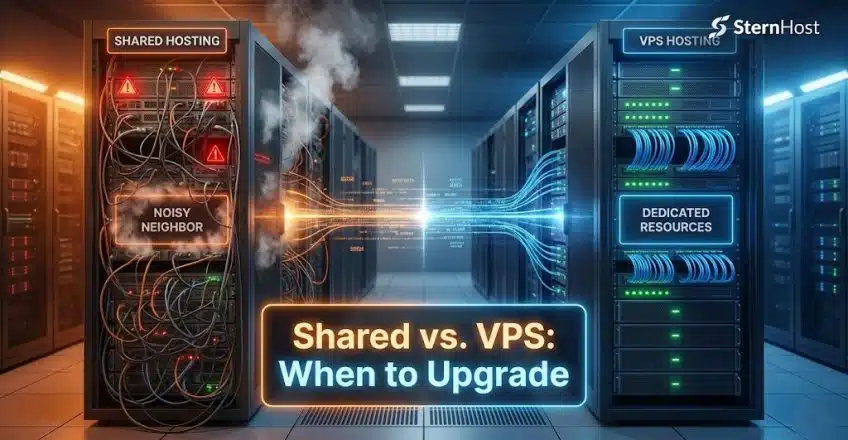
Shared Hosting is like living in a college dorm. You have your own room (your website), but you share the bathroom, the kitchen, and the hallway with hundreds of other students (other websites). If the guy down the hall throws a massive party (gets a huge traffic spike), the noise and congestion bother you. You are fighting for resources.
-
Dedicated Hosting is like buying a detached mansion. It’s huge, private, and entirely yours. However, it is also incredibly expensive and often too much space for a mid-sized family.
VPS hosting (Virtual Private Server) sits perfectly in the middle. It is the “Townhouse” or “Luxury Condo” of the internet.
Physically, you are still in a building with others (the physical server). However, virtualization technology erects steel walls between you and your neighbors. You get your own private entrance, your own kitchen, and your own amenities.
-
Isolation: What your neighbors do does not affect you.
-
Dedicated Resources: You have a guaranteed amount of RAM and CPU power that belongs only to you. No one can “borrow” your resources.
The “Noisy Neighbor” Effect: Why Shared Hosting Fails at Scale
The primary driver for moving to VPS hosting is eliminating the “Noisy Neighbor” effect.
On shared hosting, resources are communal. If another website on your shared server goes viral, gets hit by a DDoS attack, or runs a poorly coded script, it drains the server’s total memory. Your website slows down, not because you did anything wrong, but because the server is exhausted.
VPS hosting eliminates this variable. Because your slice of the server is virtualized and fenced off, your performance becomes predictable. A viral post on a neighboring site will simply bounce off your virtual walls. For a global business where consistency is key, this reliability is non-negotiable.
The Power of Control: Root Access in VPS Hosting
For developers and tech-savvy business owners, the allure of VPS hosting is often about control.
Shared hosting is like a rented hotel room: you can’t paint the walls, change the furniture, or install new appliances. You are stuck with the configuration the host provides (PHP versions, server modules, security limits).
VPS hosting hands you the keys to the castle. Most VPS plans come with “Root Access.” This means you are the administrator of your environment.
-
Need to install a custom software stack? You can.
-
Need to tweak the server configuration for a specific application? You can.
-
Need to restart a specific service without asking support? You can.
VPS hosting transforms your server from a static product into a dynamic tool that adapts to your specific business requirements.
Security and Isolation: The VPS Hosting Advantage
Security is a major concern for any global entity. While shared hosting is generally secure, the shared environment introduces theoretical risks. If a hacker gains access to the main directory of a shared server, there is a remote possibility they could affect other accounts.
VPS hosting provides a much higher level of security through isolation. Your file system is completely separate from other users. Furthermore, because you have root access, you can implement your own robust security measures. You can configure your firewalls, set up strict access rules, and install advanced security patches faster than a shared host might roll them out globally.
Scalability: How VPS Hosting Grows With You
One of the most beautiful aspects of VPS hosting is its elasticity.
Imagine you are running a marketing campaign. You expect your traffic to double next month. On a dedicated server, upgrading requires physically buying new RAM sticks and shutting down the server to install them. It’s a hassle.
With VPS hosting, resources are virtual. If you need more RAM or CPU power, you can often scale up your plan with the click of a button. It is instant and seamless. This allows you to pay for what you need today, with the confidence that you can scale up to what you need tomorrow without migrating your data.
Conclusion: Is It Time to Switch to VPS Hosting?
If your website is generating revenue, capturing leads, or serving a global audience, you cannot afford to be at the mercy of a shared environment.
The transition to VPS hosting is more than just a technical upgrade; it is a declaration of maturity. It signals that your business requires stability, speed, and security.
At SternHost, we offer high-performance VPS hosting solutions powered by NVMe drives, giving you the dedicated power you need to conquer the global market.
[Explore our Managed VPS Hosting plans and give your growing business the home it deserves.]