
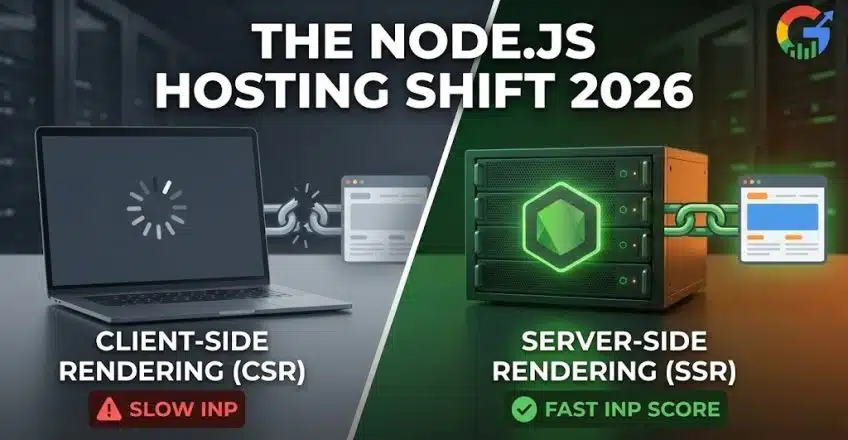

The “Heavy” Frontend is Dead: Why 2026 is the Year of Nodejs Hosting and SSR
If you are still shipping massive JavaScript bundles to the browser in February 2026, your website is officially obsolete.
The global development community is currently undergoing its biggest architectural shift since 2016. The days of the “Loading Spinner”—where users stare at a blank white screen while a React app hydrates—are over. Driven by the new Node.js 24 LTS and Google’s aggressive Core Web Vitals updates, the industry is rushing back to the server.
Here is the breakdown of why the “Client-Side Era” is ending and why robust Nodejs Hosting is the new infrastructure standard.
1. Node.js 24: The “Speed” Update
With the release of Node.js 24 as the Active LTS (Long Term Support) version, the platform has eliminated the bottlenecks that previously kept some developers on Go or Rust.
For the first time, Node feels truly “Cloud Native” out of the box.
-
Native TypeScript Support: Developers can now run
.tsfiles directly without heavy compilation steps, speeding up deployment cycles significantly. -
Built-in .env Support: The days of installing
dotenvare gone. Node 24 handles environment variables natively, making configuration on Nodejs Hosting environments safer and faster. -
The V8 Engine Boost: With the updated V8 engine, server startup times are faster than ever. This is critical for Server-Side Rendering (SSR), where every millisecond counts for SEO.
2. Google’s “INP” Metric Killed Client-Side Rendering
Why the sudden panic? You can blame Google.
In early 2026, the impact of Google’s Interaction to Next Paint (INP) metric is fully being felt.
-
The Problem: Traditional Single Page Apps (SPAs) rely on the user’s phone to render the page. If the user has a cheap Android device, the site freezes. Google now punishes these sites with lower rankings.
-
The Solution: Move the work to the server. By using Nodejs Hosting to pre-render pages (SSR) with frameworks like Next.js 16 or Remix, you send a finished HTML page to the user. The result? A perfect Green Score on PageSpeed Insights.
3. The Return of the Monolith
Microservices are still useful, but 2026 is seeing a trend toward “Modular Monoliths.” Startups are realizing that managing 50 different serverless functions is a nightmare. Instead, they are deploying unified applications.
Why Modular Monoliths Require Dedicated Nodejs Hosting
This architectural shift changes your infrastructure needs. You cannot run a heavy monolithic application on a tiny, ephemeral function.
To handle the memory requirements of a unified app, you need persistent Nodejs Hosting that offers dedicated RAM and CPU resources. This setup simplifies debugging and significantly reduces the “Cold Start” latency found in serverless functions, ensuring your app is always ready to respond instantly.
Conclusion: Infrastructure Matters Again
Your code might be clean, but if your infrastructure is outdated, your performance will suffer.
You cannot run a modern, high-performance SSR application on cheap, shared hosting designed for WordPress blogs. You need a dedicated environment that supports persistent processes, newer Node versions, and high RAM availability.
[Stop losing users to slow load times. Upgrade your infrastructure to SternHost’s optimized Node.js Hosting and deploy your Next.js or Express apps with 99.9% uptime.]