

The Edge Hosting Revolution: Why Your “Fast” Server is Now Obsolete (2026 Edition)
For the last ten years, the formula for a fast website was simple: Buy a powerful server in a central location (like Virginia or Frankfurt) and put a Content Delivery Network (CDN) in front of it. The server did the thinking, and the CDN delivered the static pictures.
In 2026, that architecture is officially dead.
With the introduction of Google’s stricter Core Web Vitals—specifically the aggressive “Interaction to Next Paint” (INP) metric—the physical distance between your database and your user has become a ranking factor. A server in New York is simply too slow for a user in Tokyo, no matter how much you pay for it.
The solution is the biggest shift in infrastructure since the cloud began: Edge Hosting. Here is why the world’s top brands are abandoning centralized servers this year, and why you should too.
What is Edge Hosting and Why Does It Matter?
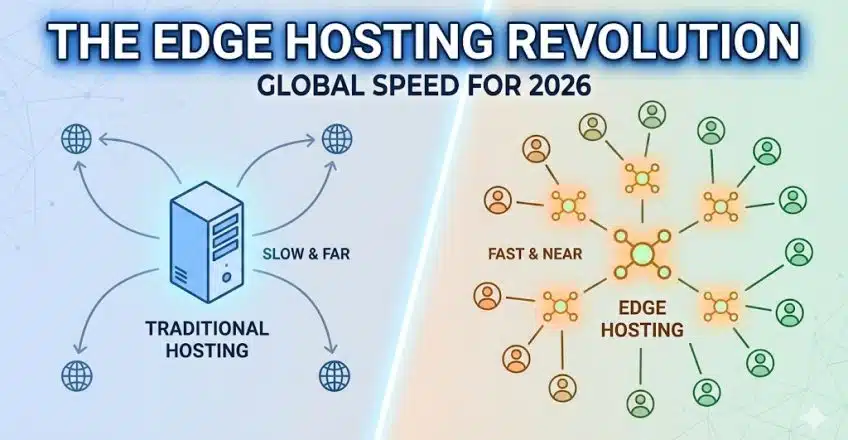
Traditional hosting lives in one place (the “Origin”). When a user visits your site, their request has to travel halfway around the world to that origin, wait for the server to build the page, and then travel back.
Edge Hosting moves the “brain” of your website to the network itself. Instead of one server, your code lives on hundreds of servers simultaneously, located in cities all over the globe.
When a user in London visits your site, the code executes in London. When a user in Sydney visits, it executes in Sydney. This reduces the “Time to First Byte” (TTFB) to near zero, effectively eliminating latency.
How Edge Hosting Solves the “INP” Crisis
In 2026, Google doesn’t just care how fast your site loads; they care how fast it reacts.
If a user clicks “Add to Cart” and the site freezes for 200 milliseconds while waiting for the server, you fail the INP metric. Failed metrics mean lower rankings.
Because Edge Hosting processes these dynamic requests geographically closer to the user, the reaction time is instantaneous. It is the only reliable way to achieve the perfect “Green Score” on Google PageSpeed Insights for global audiences.
Serverless Architecture and Edge Hosting
You might hear developers talk about “Serverless” in the same breath as the Edge. They go hand-in-hand.
With Edge Hosting, you don’t rent a specific machine with fixed RAM or CPU. You simply deploy your code, and the platform automatically scales it up or down based on traffic. If 10,000 users hit your site at once, the Edge network instantly spins up resources to handle it.
This is critical for security as well. As we discussed in our guide on [Cybersecurity Threats 2026], automated bot attacks can overwhelm a single server. Edge networks absorb these spikes effortlessly.
Conclusion: The End of the “Origin”
The internet of 2026 is too heavy and too fast for single-location servers. Whether you are running a WordPress blog or a complex SaaS application, the physics of distance will eventually catch up with you.
If you are struggling with slow load times despite having “good hosting,” the problem isn’t your code—it’s your geography. It is time to stop optimizing the origin and start moving to the Edge.
[Ready to go global? Upgrade to SternHost’s next-gen Edge Hosting plans and put your website in 150+ cities instantly.]