
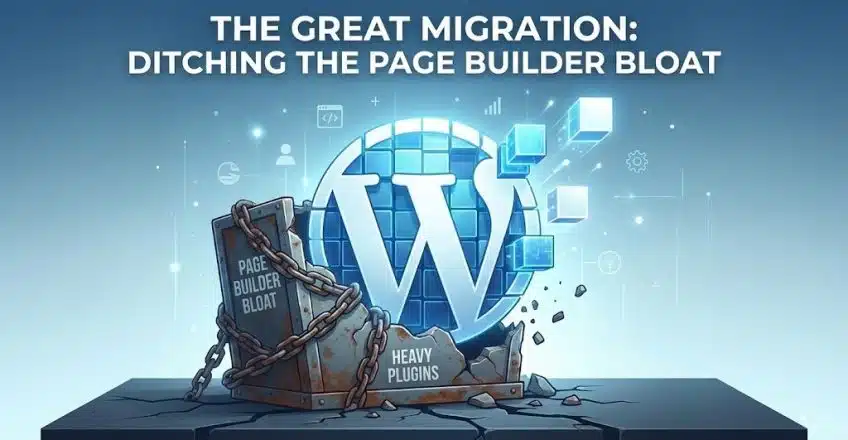

For the better part of a decade, if you wanted to build a beautiful, custom WordPress site without knowing how to code, you really only had one option: install a third-party WordPress page builder.
Tools like Elementor, Divi, and Beaver Builder became the standard. They offered drag-and-drop freedom that the classic WordPress editor simply couldn’t match. But they came with a cost: “bloat.” They added heavy code, slowed down loading speeds, and often required expensive annual licenses.
Fast forward to early 2026, and the landscape has shifted dramatically. The native WordPress Block Editor (Gutenberg) has matured from a clunky writing tool into a full-fledged design suite.
We are seeing a massive trend in the hosting space: developers and agencies are migrating away from third-party builders and returning to WordPress Core. Here is why this shift is happening now and what it means for your website.
The Performance Gap: “Bloat” is Out
We have discussed Core Web Vitals extensively, but Google’s requirements for speed have only gotten stricter.
A typical WordPress page builder loads a massive amount of CSS and JavaScript files on every page load—even if you aren’t using them. It’s like packing for a weekend trip but bringing your entire wardrobe “just in case.”
The native Block Editor helps solve this. It is built into the core of the software. It loads cleaner, lighter code that browsers can parse instantly. In 2026, where a millisecond difference can affect ad revenue and SEO rankings, the “performance tax” of a third-party builder is becoming harder to justify.
Full Site Editing (FSE): The Game Changer
The release of WordPress 6.x series solidified the concept of “Full Site Editing.”
Previously, the Block Editor was only for blog posts. Now, you can use blocks to design your headers, footers, 404 pages, and archive templates. You can control the global styles of your site—typography, color palettes, and layout spacing—without installing a single plugin.
This was the last stronghold of the WordPress page builder. Now that the native core can handle headers and footers effectively, the main reason to pay for a Pro license is vanishing.
The “Lock-In” Effect
Have you ever tried to deactivate a page builder plugin? It’s a nightmare. Your beautiful layout instantly breaks, leaving behind a mess of “shortcodes” (text that looks like [vc_row]...[/vc_row]) instead of your content. You are effectively held hostage; you cannot leave the plugin without rebuilding your site from scratch.
By building with the native block system, you are future-proofing your site. Your content is stored in standard HTML. If you change themes or switch hosts, your content remains intact. In an era where data portability is key, this freedom is a major selling point.
When Do You Still Need a Page Builder?
Is the WordPress page builder dead? Not quite.
For highly complex, interactive designs that require advanced animations, dynamic content loops, or very specific marketing funnel layouts, tools like Elementor still offer features that Core lacks. They are still powerful tools for specific use cases.
However, for the standard business brochure site, the blog, or the simple e-commerce store, the native tools are now more than sufficient.
Conclusion: Simplicity Wins
The trend in the hosting and WordPress space for 2026 is “Native First.”
The ecosystem is moving toward simplicity. Fewer plugins, less code, and more reliance on the robust features already built into WordPress. If you are planning a redesign this year, challenge your developer (or yourself) to see how far you can get without installing a heavy builder. You might be surprised by how fast your new site flies.
[Is your site weighed down by heavy plugins? Switch to SternHost’s high-performance servers to offset the load, or ask our team about optimizing your WordPress install.]