
The Rise of Vibe Coding: Top Apps & Tools for 2026
If you have checked Twitter (X) or GitHub recently, you have likely noticed a massive shift. The era of memorizing syntax, fighting with semicolons, and debugging obscure error messages is fading. In its place, a new movement has emerged: Vibe Coding.
Coined by AI researcher Andrej Karpathy, this term describes a new way of building software where the human provides the “vibe” (the intent, the high-level logic, and the aesthetic), and an Artificial Intelligence handles the actual implementation. It is no longer about writing code; it is about managing a really smart junior developer who types at 1,000 words per minute.
Here is your complete guide to this 2026 phenomenon and the Vibe Coding apps you need to master it.
What is Vibe Coding? (The “Manager” Mindset)
In the past, if you wanted to build a website, you had to know HTML, CSS, and JavaScript. Today, you just need to know English.
Vibe Coding is the practice of “programming via prompts.” You tell the AI, “Make me a portfolio site that feels like a 90s retro arcade game,” and the AI generates the file structure, the React components, and the CSS animations instantly.
The developer’s role has shifted from writer to reviewer. You are no longer the bricklayer; you are the architect. This shift has lowered the barrier to entry, allowing founders, designers, and product managers to ship production-ready apps without writing a single line of code themselves.
Top Apps Dominating the Market
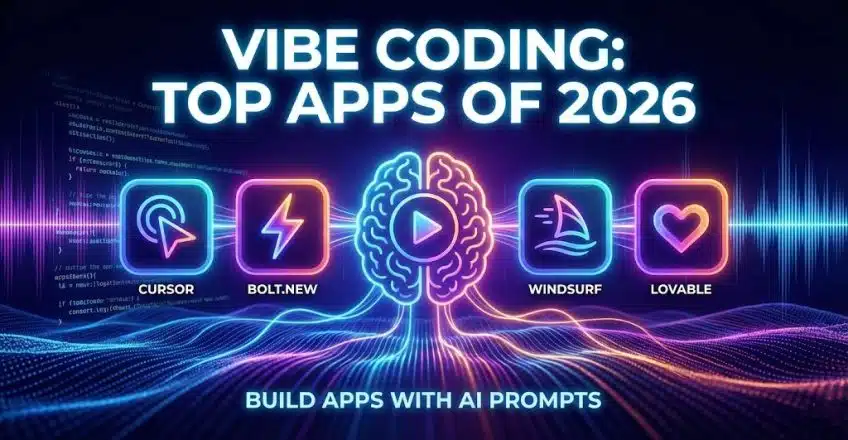
The market is flooded with AI assistants, but only a few have earned the “S-Tier” status in 2026. Here are the top contenders.
1. Cursor: The Premier Vibe Coding Editor
Cursor remains the king of the market for professional engineers. It is a fork of VS Code, meaning it works exactly like the editor you are used to, but with a brain.
-
The Vibe: “I am an expert engineer, help me speed up.”
-
Killer Feature: Its “Composer” mode allows you to edit multiple files simultaneously. You can say, “Refactor the authentication system,” and Cursor will rewrite the backend, frontend, and environment variables in one go.
2. Bolt.new (The Browser Builder)
If you don’t want to install anything, Bolt.new is the winner. It runs entirely in your browser.
-
The Vibe: “I have an idea, let me see it live in 30 seconds.”
-
Killer Feature: It handles the full stack. Unlike other tools that just give you snippets, Bolt spins up a development server instantly so you can interact with your app as you “vibe code” it.
3. Windsurf (The “Flow” State)
Windsurf is a newer competitor that focuses on context. It uses a “Cascade” flow that deeply understands your project’s history.
-
The Vibe: “Don’t just write code, understand my business logic.”
-
Killer Feature: It excels at visualizing data flows, making it easier to debug complex logic without digging into the raw code.
How Vibe Coding Changes Hosting Needs
There is one catch to this revolution. AI can write the code, but AI cannot host the code for you.
Once your AI assistant generates that amazing Node.js app or WordPress plugin, you still need a robust infrastructure to keep it online. Many “vibe coders” make the mistake of leaving their projects in expensive sandbox environments rather than moving them to production servers.
To turn your “vibe” into a real business, you need reliable infrastructure. As we discussed in our guide on [Internal Link: Node.js Hosting Shift 2026], modern apps require persistent environments to handle real user traffic without crashing.
Conclusion: Embrace the Vibes
The resistance to AI coding is over. In 2026, the best developers are the ones who can prompt the best results. Whether you are using Cursor to refactor a monolith or Bolt to launch a startup in a weekend, Vibe Coding is the skill of the decade.
Don’t just watch the revolution—prompt it.
[Have you built an app using Vibe Coding? Deploy it instantly on SternHost’s high-performance servers and show the world what your vibes can do.]