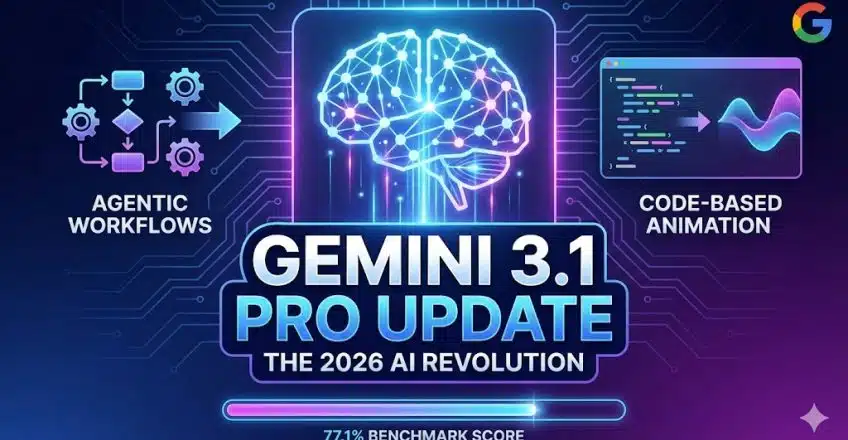

On February 19, 2026, Google sent shockwaves through the tech industry by releasing the highly anticipated Gemini 3.1 Pro Update. Unlike previous iterations that focused on broad feature expansions, this mid-cycle release is entirely dedicated to deep, complex reasoning and autonomous agentic workflows. For developers, businesses, and content creators operating in the fast-paced digital ecosystem, this represents a monumental shift in how artificial intelligence handles intricate problem-solving.
The tech world was caught off guard by the sheer processing power of this new release. According to verified benchmarks, this model achieved a stunning 77.1% on the ARC-AGI-2 test, effectively doubling the reasoning capabilities of the standard Gemini 3 Pro model. This benchmark is notorious for throwing entirely new logic patterns at AI, proving that this upgrade isn’t just regurgitating trained data; it is actively thinking through novel scenarios.
The Incredible Gemini 3.1 Pro Update and the 2026 AI Revolution
This leap in cognitive architecture means the AI is no longer just a chatbot. It is built for situations where a simple answer is completely insufficient. Whether you are synthesizing massive, contradictory datasets into a single dashboard or attempting to map out a highly complex software architecture, the cognitive load is handled with unprecedented accuracy.
Why the Gemini 3.1 Pro Update Changes Everything
One of the most jaw-dropping features of the new model is its ability to execute multi-step, autonomous tasks. Google has designed this architecture to be the engine behind “agentic workflows,” fundamentally changing how we interact with machines.
Here is what the model can now do independently:
-
Use external tools and APIs without constant human prompting.
-
Evaluate its own progress and resolve roadblocks dynamically.
-
Generate animated SVGs directly from text prompts, writing pure, scalable code instead of heavy pixel-based videos.
This means you can generate a flawless, moving graphic for your website that takes up mere kilobytes of space and remains perfectly crisp on any screen size.
Agentic Workflows in the Gemini 3.1 Pro Update
As AI models become more autonomous and capable of generating complex web applications on the fly, the underlying infrastructure supporting these applications must evolve. You can no longer rely on sluggish, outdated servers when deploying Next.js or Node.js applications built by advanced AI tools.
To fully harness the power of agentic AI coding, your applications require environments that offer persistent, high-speed execution. As we explored in our previous guide on [Internal Link: Vibe Coding Apps 2026], turning these AI-generated concepts into production-ready platforms requires a robust server architecture that guarantees low latency and high uptime.