
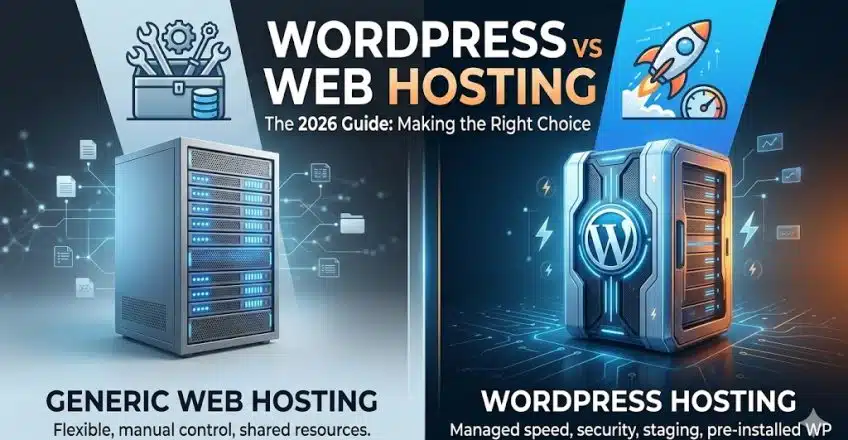

When launching a new digital project in 2026, the very first technical hurdle you will face is selecting the right server environment. The terminology can be incredibly confusing, especially when providers throw dozens of acronyms at you at checkout. However, getting this foundational step wrong can lead to sluggish page load times, severe security vulnerabilities, and ultimately, a massive loss in global revenue.
The most common dilemma modern site owners face today is deciding between a specialized environment and a generic one. While they might sound identical to a beginner, the infrastructure behind them is drastically different.
The Core Debate: WordPress Hosting vs Web Hosting Explained
To understand the difference, you must first understand what standard web hosting actually is. Traditional web hosting is a generic, blank-slate server space. It is designed to host any kind of website file, whether it is a custom HTML script, a Ruby on Rails application, or a simple PHP forum.
Because it must cater to everything, standard hosting is not optimized for anything in particular. You are essentially renting an empty room and are entirely responsible for furnishing it, securing it, and making sure everything runs efficiently.
Feature Breakdown: WordPress Hosting vs Web Hosting
Specialized WordPress hosting, on the other hand, is a server environment custom-built from the ground up to run one specific Content Management System (CMS) flawlessly. Every firewall rule, caching layer, and PHP memory limit is hardcoded to make WordPress operate at maximum efficiency.
When comparing the two, the advantages of a specialized environment become instantly clear for content creators and eCommerce brands:
-
Pre-Configured Environments: You do not need to manually install databases or configure basic core files. The CMS is ready the moment you purchase the plan.
-
Automated Updates: Specialized hosts automatically push critical core and plugin updates, ensuring you are never running vulnerable software.
-
Expert Support: If your site crashes, a generic host will blame your code. A specialized host has technicians who actually understand the specific database structure and can fix the issue immediately.
Performance Impact: WordPress Hosting vs Web Hosting
Perhaps the most critical difference lies in speed. A standard server relies on basic caching protocols that often conflict with heavy page builders. A dedicated WordPress server utilizes advanced object caching protocols like Redis or Memcached natively at the server level.
As we discussed in our recent breakdown of the [Internal Link: Best WordPress SEO Plugins], having the right on-page tools is useless if your underlying server is too slow to serve the content to Google’s bots. Search engines in 2026 ruthlessly penalize slow websites. The specialized caching mechanisms inherent to WordPress-specific servers guarantee a Time to First Byte (TTFB) that generic servers simply cannot match.
[Why settle for generic speeds? Upgrade to SternHost’s globally distributed Managed WordPress servers and watch your Core Web Vitals scores skyrocket instantly.]
Making the Final Choice: WordPress Hosting vs Web Hosting
If you are a highly technical developer building a completely custom web application from scratch using Python or raw PHP, standard web hosting gives you the blank canvas you need.
However, if you are among the 40% of the internet using the world’s most popular CMS to run your blog, corporate site, or WooCommerce store, opting for a generic server is a massive mistake. The time you save on troubleshooting, manual updates, and speed optimization far outweighs any minor price difference between the two tiers.