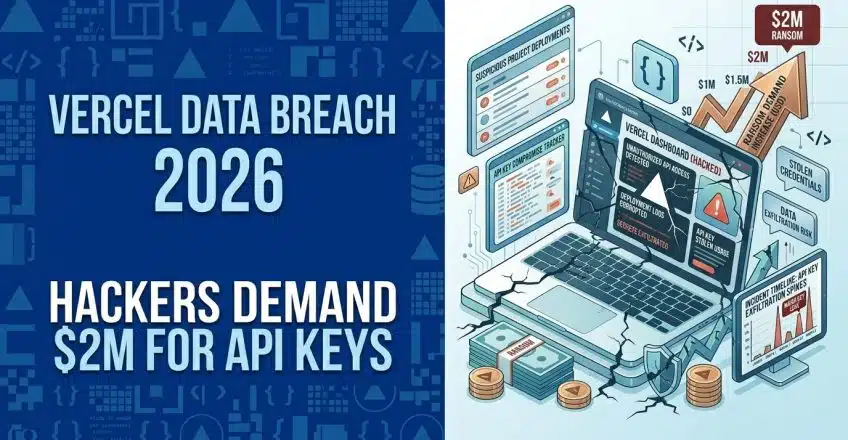

Modern full-stack development relies heavily on automated Platform-as-a-Service (PaaS) providers to streamline deployment pipelines, but this convenience creates massive centralized targets. On April 19, 2026, Vercel officially disclosed a significant security incident involving unauthorized access to its internal systems. While the company issued a brief statement confirming that a “limited subset” of customers was affected, the situation rapidly escalated on the dark web. A threat actor, claiming affiliation with the notorious ShinyHunters group, posted the allegedly stolen dataset on BreachForums with a staggering $2 million price tag.
The initial disclosure has sparked intense scrutiny across the global developer community. Vercel confirmed the intrusion and engaged external incident response specialists, but the company has remained quiet on critical details, including how the breach occurred and the exact duration of the exposure. For engineering teams relying on modern React, Node.js, and API-heavy architectures, the potential fallout from this incident extends far beyond simple website downtime.
Unpacking the Vercel Data Breach 2026: What Was Stolen?
To prove the authenticity of their $2 million asking price, the threat actor leaked a sample containing 580 employee records, which included names, email addresses, and internal activity timestamps. However, the true danger lies in the broader dataset the hackers claim to possess. According to the dark web listing, the stolen files include internal database contents, source code repositories, screenshots of enterprise dashboards, and crucially, active API keys, GitHub tokens, and NPM tokens.
The security firm Slow Fog Technology assessed that the compromise likely stems from the leakage of Vercel’s internal Linear project management and user management systems. Vercel has clarified a critical distinction regarding customer data: environment variables explicitly marked as “sensitive” remained encrypted and protected. Unfortunately, standard environment variables—often used by developers to store database URIs, third-party API keys, and endpoint credentials—were potentially exposed in plain text.
-
Rotate standard secrets: Any credentials not explicitly designated as “sensitive” within the deployment dashboard must be immediately revoked and rotated.
-
Audit access logs: Review GitHub and NPM access logs for any unauthorized commits or package publications originating from unknown IP addresses.
-
Upgrade variable security: Moving forward, all production secrets must be wrapped in the platform’s encrypted sensitive variable feature to prevent plaintext exposure.
Web3 and the Vercel Data Breach 2026 Fallout
The incident surface of a PaaS compromise is vastly different from a traditional shared server breach. When developers connect a GitHub repository or an NPM registry to an automated build pipeline, the tokens generated act as absolute credentials. If the attackers possess valid GitHub or NPM tokens from this incident, they do not need to break into the underlying servers; they can simply push malicious commits to private repositories or publish poisoned package updates directly to the global registry.
This exposure is particularly devastating for the crypto and Web3 sectors. A massive share of decentralized application frontends, wallet connector integrations, and RPC endpoints rely on PaaS environments. If standard environment variables holding critical endpoint credentials were breached, bad actors could easily intercept or redirect blockchain transactions.
Industry Backlash Over the Vercel Data Breach 2026 Disclosure
The handling of the incident communication has drawn sharp criticism from cybersecurity professionals. The breach became public knowledge on a Sunday, and a massive portion of the customer base discovered the intrusion through a viral Hacker News thread long before receiving an official email notification. Security experts have pointed out that instructing customers to merely “review” their environment variables is wildly insufficient. Given the unquantified downstream exposure in the Vercel Data Breach 2026, the only safe protocol is a mandatory, immediate rotation of all credentials.
This event forces a critical re-evaluation of the implicit trust developers place in environment variable models. Storing high-privilege keys in the cloud requires absolute internal system security—an assumption this $2 million extortion attempt has severely undermined.
If your digital infrastructure processes sensitive user data or complex API integrations, relying on third-party deployment platforms that obscure their internal security failures is a massive operational risk.