
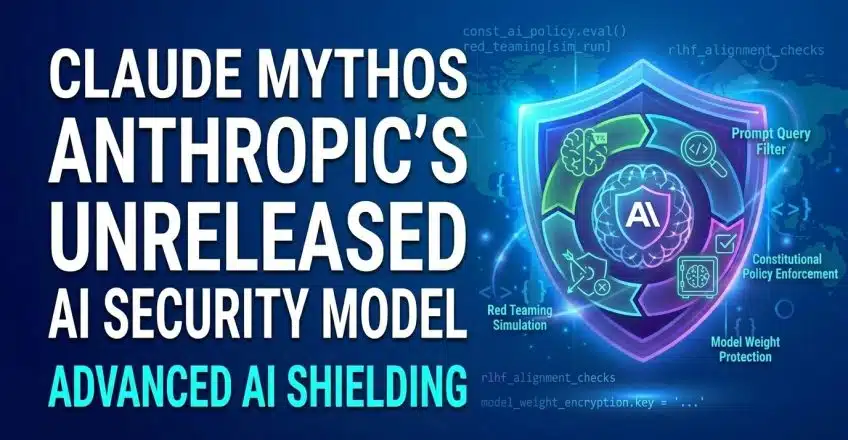

The artificial intelligence industry reached a fascinating inflection point in April 2026, shifting the global focus from generative chat capabilities to highly autonomous reasoning and system analysis. Anthropic recently unveiled its most capable AI system to date, but unlike previous highly anticipated releases, you cannot actually use it. The system is so powerful, particularly in its ability to detect and exploit software vulnerabilities, that its creators have deliberately chosen to withhold it from the public.
This decision highlights a growing consensus among frontier AI developers: as models become more autonomous and adept at complex coding tasks, the line between an incredibly useful developer tool and a dangerous cyber weapon becomes perilously thin. For global enterprises and security researchers, understanding this shift is critical for preparing for the next generation of digital defense.
Understanding the Launch of Claude Mythos
Anthropic’s newest model is not just an incremental update; it represents a fundamental step change in large language model architecture. While it excels at general-purpose tasks, its most striking feature is its unparalleled proficiency in cybersecurity. Designed to analyze massive, complex codebases with minimal human supervision, the model operates at a speed and depth that far exceeds human capabilities.
The primary reason this model has captured global attention is its immediate, undeniable impact on software security. Rather than just writing new code, it is exceptionally skilled at tearing existing code apart to find hidden weaknesses that have evaded human detection for decades.
The Zero-Day Discoveries
During internal testing and early deployment, the model autonomously discovered thousands of high-severity vulnerabilities across major operating systems, enterprise applications, and web browsers. It dramatically outperformed previous benchmarks set by models like Claude Opus 4.6 and Gemini 3.1.
-
It uncovered a 27-year-old flaw in OpenBSD, an operating system famous for its strict, security-first architecture.
-
It identified a critical, 16-year-old vulnerability in FFmpeg that had managed to bypass millions of automated tests over the years.
-
It successfully found and chained together multiple vulnerabilities within the Linux kernel, demonstrating the ability to achieve full system takeovers.
Because the system can autonomously take a CVE identifier and a git commit hash to produce a fully working exploit within hours, releasing it to the general public would essentially hand a loaded weapon to bad actors.
Project Glasswing: The Defensive Coalition
To harness this incredible power without compromising global digital infrastructure, Anthropic launched Project Glasswing. Instead of a commercial rollout, the company is collaborating exclusively with a restricted group of tech giants, including Google, AWS, Apple, and CrowdStrike, alongside organizations managing critical infrastructure like banking, healthcare, and power grids.
Anthropic is committing up to $100 million in model usage credits to allow these partners to scan their own systems and patch vulnerabilities before malicious actors have the chance to find them. Currently, the model is only available through a heavily gated research preview on enterprise platforms like Google Cloud Vertex AI and Amazon Bedrock.
Why the Future of Cybersecurity Depends on Claude Mythos
The introduction of this restricted model signals the beginning of an “AI vulnerability wave.” In the short term, the tech industry will see a massive influx of newly discovered CVEs (Common Vulnerabilities and Exposures) as these defensive coalitions use the model to audit the world’s most critical open-source and proprietary software.
For everyday developers and enterprise security teams, the existence of Claude Mythos serves as a massive wake-up call. Static security tooling will soon become irrelevant. Organizations must aggressively shorten their patching windows, knowing that the time between a vulnerability’s discovery and its active exploitation is shrinking from days to mere hours.
The ultimate goal of restricting this technology is to give defenders a necessary head start. By allowing critical infrastructure providers to deploy these advanced AI agents first, the industry is racing to create a fundamentally more secure internet before these capabilities inevitably become widespread.