
Think about the last time you opened a prompt window. You likely asked it to draft a polite email to a frustrating client, brainstorm a few quick marketing ideas, or summarize a lengthy PDF. This is how the vast majority of entrepreneurs interact with artificial intelligence today. It is treated as a digital intern for one-off, low-stakes chores. While this saves a few minutes here and there, it completely misses the architectural shift happening in the global digital economy. The companies thriving right now are not using these models to write subject lines; they are integrating them deeply into their core infrastructure to run entire operational departments.
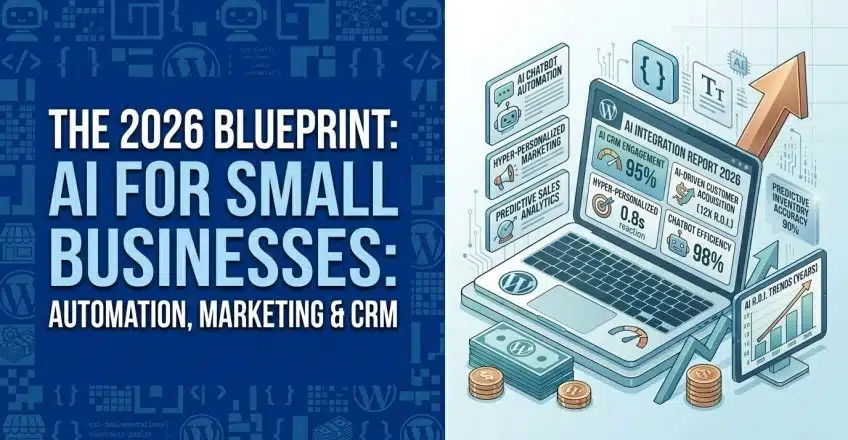
The 2026 Blueprint: AI for Small Businesses
To truly scale your operations without linearly increasing your headcount, you must transition from using artificial intelligence as a passive tool to deploying it as an active operational engine. This requires a fundamental shift in how you view your digital presence, your customer interactions, and your daily administrative workflows.
The most urgent shift is happening in how customers find you. For a decade, the strategy was simple: build a fast website, optimize your keywords, and rank on traditional search engines. Today, consumers are increasingly bypassing standard search entirely, asking conversational engines like Perplexity or ChatGPT to recommend a local accountant, a specialized developer, or a B2B service provider. When these engines formulate an answer, they do not just crawl your homepage. They aggregate the entire digital conversation happening about your brand across the internet.
-
Build robust pillar content: Instead of generic, short-form blog posts, turn your ten most frequently asked customer questions into comprehensive, deeply researched articles. Address the exact problems people face before, during, and after buying your product. These are the specific, authoritative sources that large language models look for to cite in their generated answers.
-
Expand your off-site footprint: If your entire digital existence lives on a single domain or one social media account, you are practically invisible to modern search models. You must be actively mentioned on industry directories, community forums like Reddit, and independent review platforms. AI models require external validation to trust that your business is worth recommending.
Redefining Marketing Strategy with AI for Small Businesses
A massive point of failure for growing brands is creating an incredible piece of content—a highly converted case study or an engaging video—and then immediately moving on to the next idea. The material sits idle after its initial launch. You can instantly multiply the lifecycle of your successful assets by transforming a single win into a sustained campaign.
-
Frictionless content multiplication: Feed your highest-performing customer testimonial or blog post into your preferred model. Instruct it to generate a month’s worth of multi-channel assets based strictly on that proven data: an email newsletter hook, three distinct social media posts with varying psychological angles, and localized ad copy. What previously took a week of strategic planning now takes twenty minutes.
-
Automated competitive analysis: You no longer need an expensive marketing agency to decode your competitor’s strategy. Paste a rival’s landing page text into a large context window and ask the model to identify their core value propositions, their pricing psychology, and the messaging gaps they left open for you to exploit.
Automating Operations and Support with AI for Small Businesses
Modern consumers no longer care if they are speaking to a human or a machine, provided their problem is solved instantly and accurately. A digital system that resolves a billing dispute at midnight is infinitely more valuable than a human agent who replies twelve hours later. However, deploying a generic, untrained widget will only frustrate your audience and damage your brand.
-
Train models on proprietary data: Do not rely on generalized knowledge. Use platforms to ingest your actual website URLs, past support tickets, and specific shipping policies. When a customer asks a complex logistical question, the bot provides a highly contextualized, accurate answer based strictly on your business rules, rather than linking to a useless generic help page.
-
Connect your invisible workflows: Utilize no-code automation platforms like n8n to eliminate administrative drag. Map out repetitive tasks, such as copying new lead data from a form into a CRM, generating an invoice, and triggering a personalized welcome sequence. Once mapped, automate the entire chain so it runs silently in the background, saving you hours every single week.
-
Enforce a strict human checkpoint: These models are prone to hallucination and will invent policies or statistics with absolute confidence if left unchecked. Always maintain a strict boundary for high-stakes interactions. Implement a rule that complex complaints, high-ticket enterprise sales, and sensitive data handling must automatically escalate to a human operator.
Running complex API integrations, automated workflow scripts, and continuous customer support bots requires rock-solid server infrastructure. If your website goes offline or your server lags, your automated funnels will instantly collapse, leaving your customers stranded and your leads cold. Deploy your intelligent digital operations on SternHost today. For just ₦1,195.00/month, you receive the enterprise-grade speed, unmetered bandwidth, and raw server reliability necessary to power your automated business flawlessly around the clock.