
The traditional process of converting a written project brief into a functional visual layout has long been a bottleneck for digital agencies and enterprise design teams. Historically, product managers and UX designers spent countless hours interpreting textual requirements, drawing low-fidelity sketches, and manually placing UI components before a client could even review the first iteration. Today, the integration of autonomous models directly into the design pipeline fundamentally changes this workflow. By leveraging natural language processing and computer vision, modern toolchains can instantly interpret a dense project brief and generate structured, editable screen layouts automatically. This paradigm shift eliminates the ambiguity of manual design handoffs, allowing agencies to prototype complex user journeys and multi-screen applications at unprecedented speeds.
Elevating Design Operations via Agentic AI wireframe translation
Moving from an abstract client brief to a tangible visual layout requires a system capable of understanding both business logic and established user experience patterns. Unlike early generative image tools that produced flat, unusable pixels, modern platforms act as intelligent assistants that comprehend structural hierarchy, component relationships, and responsive grids.
When a project manager uploads a detailed request for proposal or a simple text prompt into a generative workspace, the underlying agent evaluates the required features—such as authentication flows, data dashboards, or e-commerce checkouts—and instantly maps them to established UI conventions. This capability drastically compresses the time required to validate a product idea, shifting the agency focus from manual pixel-pushing to strategic user experience refinement.
The Core Mechanics of Agentic AI wireframe translation
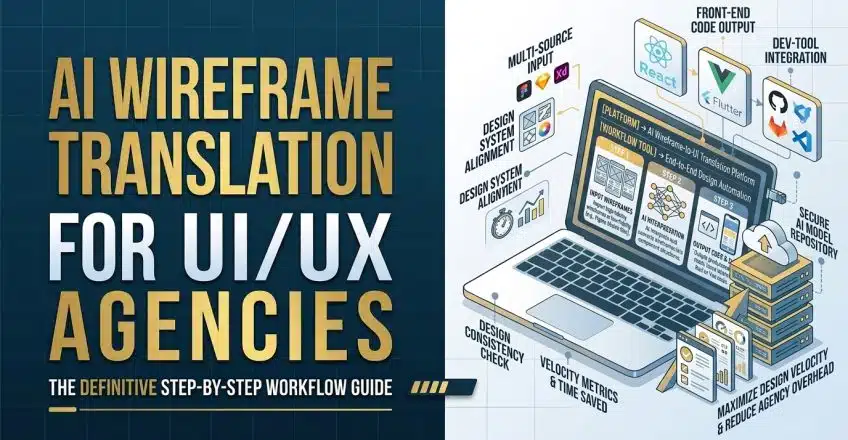
The technical foundation of this automated workflow relies on specialized large language models trained specifically on front-end code patterns, accessibility rules, and design system constraints. When initiating a project, the agentic system ingests multimodal inputs—ranging from plain-text feature lists to uploaded photos of whiteboard sketches—and reverse-engineers the intent into a standardized format.
Once the intent is parsed, the engine selects appropriate UI elements from an internal component library and arranges them according to optimal user flow logic. The resulting output is not a static image, but a fully functional, editable structure that can be exported directly into professional environments like Figma or translated straight into React code.
-
Multimodal ingestion allows the system to process text prompts, legacy screenshots, and rough hand-drawn sketches simultaneously to establish a baseline structure.
-
Dynamic component mapping automatically assigns standardized layout elements like navigation bars, hero sections, and data tables based on the context of the client brief.
-
Framework-aware exporting ensures that generated wireframes maintain proper Auto Layout properties, enabling seamless handoff to engineering teams without manual restructuring.
Implementing Agentic AI wireframe translation in Enterprise Pipelines
Adopting autonomous design generation requires agencies to restructure their initial client discovery phases. Instead of delaying visual feedback until the end of a multi-week sprint, teams can now generate and iterate on structural wireframes live during the initial kickoff call. Tools like UX Pilot, Visily, and natively integrated features like Figma Make allow stakeholders to adjust layouts, swap sections, and update placeholder copy through conversational prompts in real time.
This rapid iteration cycle fundamentally alters the economics of agency operations. By eliminating the manual labor associated with low-fidelity wireframing, agencies can explore a higher volume of creative variants, testing different architectural approaches before committing engineering resources. The autonomous agent handles the tedious execution of establishing grids, spacing logic, and baseline typography, while the human designer focuses on high-level brand alignment and complex edge-case interactions.