
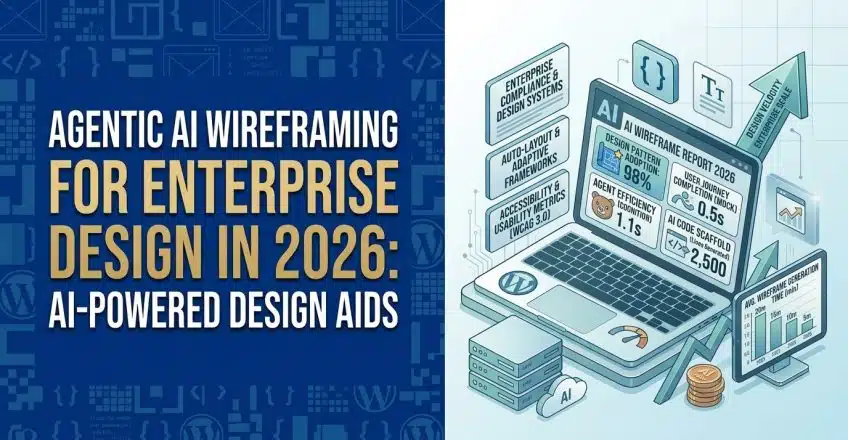

The translation of abstract client requirements into functional digital interfaces represents one of the most resource intensive phases in enterprise web development. Historically, product managers and UX engineers spent weeks interpreting dense textual briefs, manually placing UI components, and iterating on low fidelity sketches before a client could review the initial architecture. Transitioning to an autonomous design pipeline eliminates this friction. By leveraging multimodal language models and generative component engines, digital agencies can instantly parse complex business logic and output structured, editable visual layouts. This architectural shift radically accelerates the prototyping phase, allowing teams to validate user journeys and edge cases at unprecedented speeds.
Scaling Agency Operations with Agentic AI wireframing
Replacing manual sketch interpretation with intelligent agents fundamentally changes how digital studios manage client intake and feature scoping. When an enterprise submits a detailed request for proposal, the autonomous system does not just generate a flat, static image. Instead, it reads the contextual requirements, maps the required data schemas, and provisions a structured component hierarchy. This ensures that the generated interface inherently understands the relationships between user authentication states, data dashboards, and dynamic content feeds.
Core Architecture of Agentic AI wireframing
The technical foundation of these autonomous workflows relies on Large Design Models trained explicitly on component driven architectures and strict accessibility rules. These systems ingest multimodal inputs and reverse engineer the client’s intent into a standardized JSON or XML format compatible with modern frontend frameworks. The agent then selects appropriate UI elements from an internal design system and arranges them according to optimal user flow logic.
Multimodal context parsing simultaneously analyzes text briefs and legacy application screenshots to establish an accurate baseline structure.
Dynamic component mapping automatically assigns structural elements like navigation grids and data tables based on semantic intent.
Framework aware exporting guarantees that generated visual layouts maintain strict structural properties for seamless developer handoff.
Implementing Agentic AI wireframing at the Edge
To support real time collaboration during initial client kickoff calls, these autonomous generation engines must operate with absolute minimal latency. By executing the interface regeneration tasks via advanced compute environments, agencies can adjust entire dashboard layouts and typography systems conversationally. The autonomous agent handles the tedious execution of establishing Document Object Model structures and CSS grids, freeing human designers to focus entirely on high level brand alignment and complex interaction states.