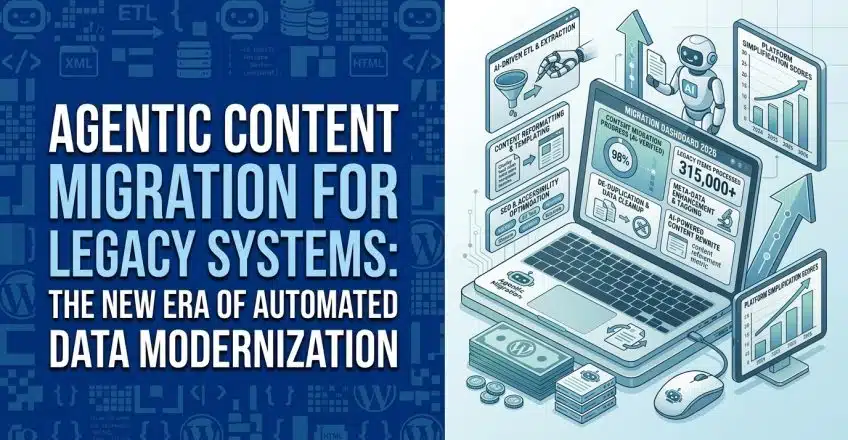

Migrating enterprise web environments away from monolithic legacy platforms is notoriously risky and labor intensive. Historically, moving thousands of web pages, custom post types, and media assets required massive engineering teams to manually map database fields and rewrite broken HTML structures. Transitioning to an autonomous migration architecture eliminates the risk of data loss and drastically accelerates digital transformation timelines. By leveraging intelligent language models, engineering teams can instantly parse unstructured legacy databases and format the output directly into modern headless schemas without writing brittle, single-use scripts.
Scaling Enterprise Upgrades with Agentic Content Migration
Traditional migration scripts rely on rigid regular expressions and static database queries that fail the moment they encounter an unexpected formatting anomaly or a deprecated plugin shortcode. Instead of relying on manual data wrangling, digital agencies now deploy intelligent systems capable of deep semantic understanding. When an autonomous pipeline reads a legacy database, it interprets the context of the content, automatically stripping out inline CSS styling, updating deprecated markup tags, and restructuring the payload to match the strict JSON requirements of a modern frontend architecture.
The Core Architecture of Agentic Content Migration
Deploying an autonomous data transfer pipeline requires advanced logic that can interpret the complex relationships between text, taxonomy, and media assets. These systems utilize specialized models trained on extensive web architectures, allowing them to map legacy categories to entirely new taxonomy trees dynamically.
-
Semantic field mapping automatically connects unstructured legacy text blobs into strictly typed interface components like hero sections and rich text blocks.
-
Media asset resolution detects hardcoded image URLs, downloads the original assets, optimizes their file sizes, and rewrites the content body with the new delivery network links.
-
Automated internal link restructuring analyzes the entire site topology to update relative paths on the fly, completely eliminating the broken links that plague manual site transfers.
Executing Agentic Content Migration in Production
To safely move gigabytes of enterprise data, systems engineers run these autonomous pipelines through highly secure staging environments. The intelligent agent pulls the raw data via the legacy REST API, processes the content transformation in an isolated memory buffer, and pushes the clean payload into the target system using GraphQL mutations. If the agent encounters a heavily corrupted database table or an unrecognized custom layout, it isolates the anomaly, flags it in a centralized dashboard for human review, and continues migrating the healthy data. This guarantees that the migration process never completely stalls due to a single localized error.