
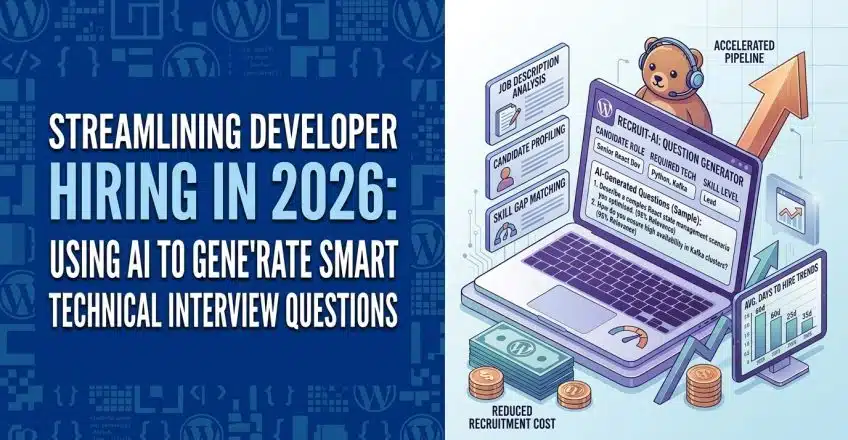

The engineering recruitment pipeline is notoriously fragile, often relying on static, generic coding assessments that fail to evaluate a candidate’s true capability within a specific enterprise environment. When scaling a technical team, depending on human engineers to manually draft complex systems design prompts or microservice debugging scenarios consumes critical sprint capacity. Transitioning to an automated assessment architecture fundamentally changes this dynamic. By feeding an intelligent agent the specific parameters of your tech stack, infrastructure, and current sprint challenges, organizations can generate hyper-contextualized assessments instantly. This ensures that every applicant is evaluated against the exact problems they will face in production, eliminating the friction of irrelevant whiteboard algorithms and significantly accelerating the path from initial screening to technical validation.
Streamlining Recruitment via AI technical interview questions
Modern development ecosystems require talent capable of navigating intricate, multi-layered environments rather than simply reciting textbook data structures. Unfortunately, traditional technical interviews frequently test memory recall rather than practical execution. Implementing intelligent generation models allows hiring managers to dynamically produce coding scenarios that mirror actual pull requests or continuous integration failures from the company’s active repository.
When an applicant progresses to the technical phase, the autonomous system evaluates their resume alongside the specific requirements of the open requisition. The agent then synthesizes a unique, multi-stage assessment. This dynamic generation completely neutralizes the risk of candidates sharing answers online, as no two assessments are identical, guaranteeing a highly accurate evaluation of individual problem-solving methodologies.
Architectural Precision in AI technical interview questions
Generating relevant assessments at scale requires deploying language models that possess deep comprehension of advanced system architecture and deployment pipelines. These systems do not merely output plain-text questions; they construct fully functional, sandboxed coding environments complete with failing unit tests or misconfigured infrastructure files that the candidate must resolve.
-
Dynamic context mapping analyzes your proprietary codebase to generate realistic bug-fixing scenarios that test actual domain knowledge.
-
Automated rubric generation creates strict evaluation criteria alongside every prompt, ensuring human interviewers grade diverse candidates with absolute consistency.
-
Real-time scenario adaptation adjusts the complexity of subsequent prompts live during the interview based on the candidate’s initial performance and architectural choices.
Automating Evaluation alongside AI technical interview questions
To maximize the efficiency of the technical screening phase, engineering organizations must couple intelligent generation with autonomous evaluation logic. Once the candidate submits their code, the system analyzes the abstract syntax tree, evaluates time and space complexity, and tests the solution against edge cases that a human reviewer might overlook. The agent then compiles a comprehensive diagnostic report, highlighting the candidate’s strengths in modular design or their vulnerabilities in memory management. This automated feedback loop allows senior engineers to bypass the tedious task of reading unoptimized boilerplate, focusing their time solely on interviewing the top percentile of applicants who have definitively proven their technical competence.