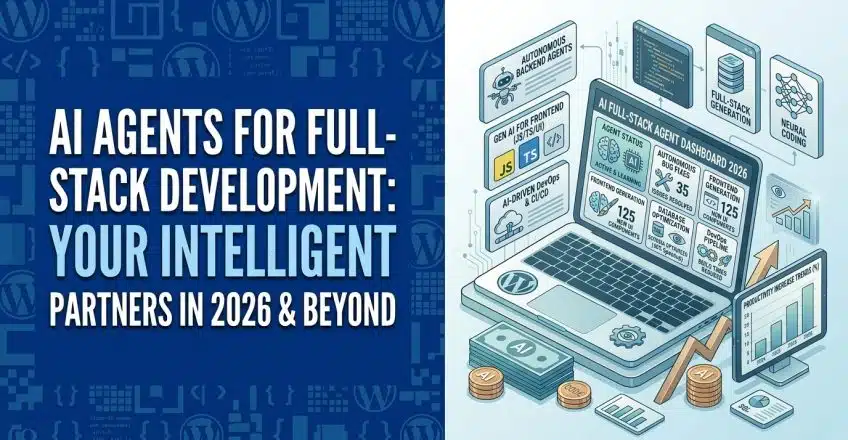

The hype surrounding artificial intelligence has officially moved away from generating basic blog posts to writing and executing complete application codebases. Developers are rapidly adopting autonomous systems that can debug database queries, refactor legacy code, and manage server deployments without human intervention. However, handing over your production API keys and terminal access to an autonomous model is incredibly dangerous without strict guardrails. The biggest challenge in 2026 is no longer getting an AI to write code; it is preventing that AI from accidentally executing a destructive command that wipes out your entire digital infrastructure.
Deploying Secure AI Agents for Full Stack Development
Transitioning to an agentic workflow requires a fundamental shift in how you view artificial intelligence. You must stop treating the model as a helpful intern and start treating it as an untrusted third-party contractor. When you ask a model to “fix the database connection,” a poorly constrained agent might decide the best solution is to drop the entire table and recreate it from scratch.
To prevent catastrophic data loss, modern engineering teams are utilizing specialized subagent architectures. Instead of giving one massive “God-mode” AI access to your entire codebase, you deploy multiple smaller, restricted agents that can only communicate through strict, validated protocols.
The orchestration model receives your instructions, breaks the task down, and hands the frontend UI work to one agent while giving the database schema update to another. This ensures a compromised or “hallucinating” frontend agent cannot accidentally execute backend SQL commands.
Sandboxing Secure AI Agents for Full Stack Development
Building a robust automation pipeline requires physical and network-level barriers between the AI’s execution environment and your actual machine. Never allow an autonomous coding tool to run directly on your bare-metal operating system.
-
Enforce Terminal Sandboxing: Always run your AI tools within hardened, ephemeral Docker containers. If the agent accidentally generates a destructive terminal command like
rm -rf /, it will only destroy the isolated container, leaving your actual machine and local files completely unharmed. -
Implement the Principle of Least Privilege: If an agent is tasked with writing CSS for your Next.js frontend, it does not need your production Stripe API keys or your Supabase administrative credentials loaded into its environment variables. Strictly scope the
.envfiles provided to each specific agent. -
Mandate Evals-First Execution: Do not allow agents to push code directly to your main Git branch. Configure your CI/CD pipeline so that the agent’s output is immediately routed to an automated testing suite. The code is only merged if it passes rigorous formatting and security evaluations.
Top Tools for Secure AI Agents for Full Stack Development
The tooling ecosystem has rapidly evolved to support these strict security requirements natively. Attempting to build these sandboxes manually is tedious and prone to configuration errors.
-
Antigravity CLI 2.0: This environment is specifically designed for complex web applications. It spins up completely isolated workspaces where its subagents can vibe code and test database migrations safely before ever requesting a merge to your live staging server.
-
Claude Code: Anthropic’s flagship terminal tool features deep native integrations with Git. It operates with a highly cautious default setting, explicitly asking for human confirmation before executing any commands that modify system files or initiate network requests.
Running multiple containerized AI agents that constantly compile code, run test suites, and execute terminal commands requires immense computational overhead. A standard shared hosting plan will instantly crash under the weight of these continuous automated workflows. Deploy your advanced, AI-driven development environments on SternHost today. For just ₦1,195.00/month, you receive the enterprise-grade server processing power, unmetered bandwidth, and unshakeable reliability necessary to scale your automated engineering workflows safely and flawlessly.