
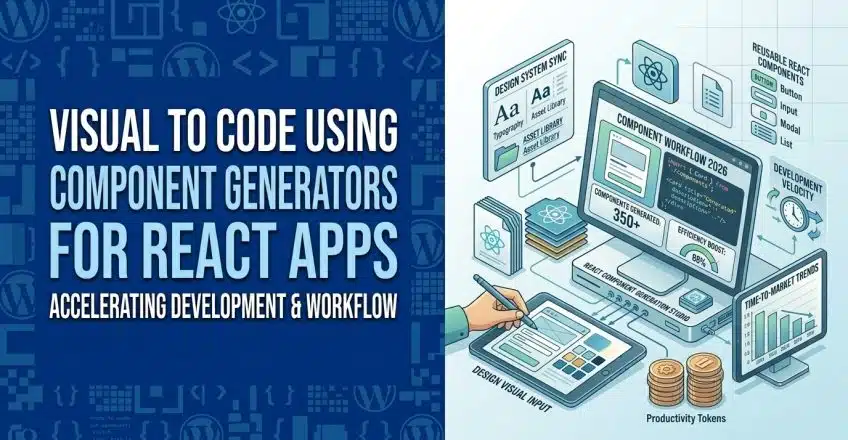

The gap between finalizing a digital design and deploying functional frontend code has traditionally been the most expensive phase of web development. Historically, translating static vector graphics into responsive layouts required engineers to manually extract CSS values, reconstruct flexbox properties, and write boilerplate state management logic. This manual handoff not only slowed down the sprint velocity but frequently introduced visual drift, where the final product no longer matched the approved design intent. Today, integrating intelligent automation directly into the workflow eliminates this friction. By reading design files natively, modern artificial intelligence models can interpret layout structures, design tokens, and spacing rules to output clean, maintainable web applications.
Accelerating Development: Visual to Code Using Component Generators
For digital agencies and enterprise teams, relying on manual translation from a Figma frame to a React environment creates an unnecessary operational bottleneck. While legacy plugins attempted to solve this by dumping absolute-positioned HTML elements, modern tools approach the problem by understanding true component composition. These advanced systems parse auto-layout settings and variant states, transforming them into modular, reusable frontend code without human intervention.
When a designer finishes a sprint, developers no longer need to spend days setting up basic structural elements. Instead, they provide the vector mockup URL to an AI-driven workspace. The system evaluates the hierarchy, extracts color and typography tokens, and generates fully responsive React or Next.js components complete with Tailwind utility classes. This shifts the engineering focus away from building basic user interface components and toward implementing complex backend business logic.
The Architecture of Visual to Code Using Component Generators
Moving from static pixels to dynamic code requires an infrastructure capable of mapping visual representations to modern web frameworks seamlessly. Advanced platforms like Locofy, UX Pilot, and GenVibe achieve this by utilizing Large Design Models (LDMs) trained specifically on frontend patterns and component-driven architecture. These engines do not just guess what a button should look like; they read the underlying vector data to guarantee pixel-perfect translation.
-
Real-time token extraction automatically converts vector style variables into centralized CSS modules or Tailwind configuration files.
-
Auto-layout interpretation natively translates design constraints into robust flexbox and CSS grid structures, ensuring responsiveness across all device .
-
Intelligent component splitting scans entire design files to identify recurring elements, automatically packaging them as reusable React components with properly defined properties.
Implementing Visual to Code Using Component Generators in Production
To successfully deploy automated translation tools, engineering teams must enforce strict file hygiene during the design phase. AI models rely on structured data; if a vector frame lacks proper naming conventions or consistent grouping, the resulting code will require manual refactoring. By standardizing how designers apply auto-layout and component variants, organizations ensure that the exported codebase remains clean and ready for immediate GitHub integration.
Once the initial code is generated, developers can utilize conversational interfaces to refine the output dynamically. If a grid needs to collapse into a single column on mobile, the developer can prompt the agent to adjust the Tailwind breakpoints without ever opening the source file manually. This capability drastically compresses the iteration cycle, allowing teams to deliver interactive, database-connected prototypes in a fraction of the time previously required.