

As enterprise Retrieval-Augmented Generation (RAG) pipelines scale beyond the tens of millions of embedding chunks, traditional in-memory vector search architectures begin to fracture. When high-dimensional floating-point datasets approach the billion-vector threshold, holding a monolithic Hierarchical Navigable Small World (HNSW) graph entirely in RAM introduces severe latency spikes and unsustainable infrastructure costs. Engineering teams attempting to intersect dense vector searches with relational metadata filters often experience runaway iterative scans, where the execution planner pulls thousands of unnecessary candidate vectors. Overcoming this bottleneck requires moving away from brute-force flat searches and adopting strict indexing optimizations that logically segregate vector storage.
Scaling Enterprise AI with Vector database partition pruning
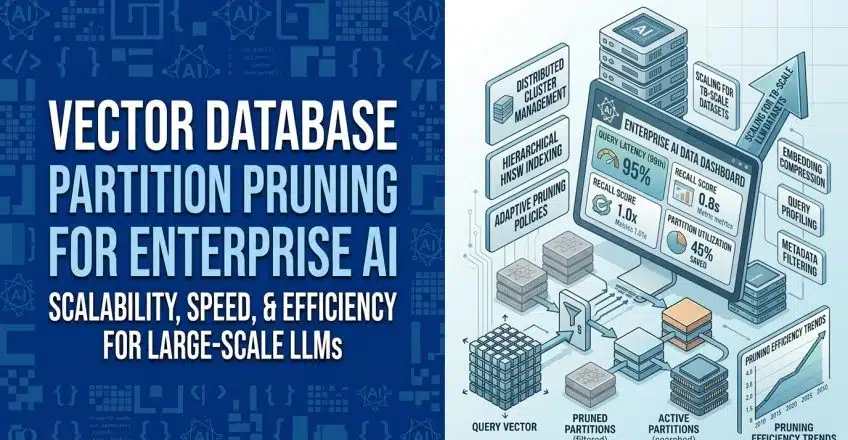
The most critical architectural shift for high-volume semantic search is native filtering capability. Unlike traditional database indexing, where B-tree structures cleanly isolate queried metadata, vector graphs operate on approximate nearest neighbor distances. If an AI agent queries a vector store for specific workspace documents using distance-based thresholds alongside metadata constraints, the engine might scan an enormous subset of irrelevant data before finding vectors that satisfy both conditions. Implementing Vector database partition pruning physically and logically segments the embedding tables, ensuring the query planner completely bypasses partitions that do not match the target metadata.
Architectural Implementations of Vector database partition pruning
For multi-tenant SaaS applications and localized AI agents, this pruning strategy effectively reduces the search space from hundreds of millions of global vectors down to the exact slice owned by a specific tenant or organization. By leveraging advanced indexing architectures, systems divide the continuous vector space into discrete clusters using k-means algorithms or explicit relational keys.
-
Horizontal sharding distributes isolated partitions across distinct storage nodes based on hard metadata constraints, eliminating the need for expensive cross-node vector distance calculations.
-
Local HNSW graph generation creates independent index structures within each isolated partition, rather than attempting to maintain a single monolithic graph across the entire dataset.
-
Materialized Common Table Expressions (CTEs) force the query engine to resolve the relational filter first, applying the compute-heavy vector distance calculations exclusively against the heavily reduced subset.
Optimizing Throughput via Vector database partition pruning
To prevent memory exhaustion during continuous data ingestion, modern AI databases deploy Product Quantization (PQ) alongside strict partition logic. By splitting 768-dimensional vectors into compressed sub-vectors, the system shrinks the raw memory footprint drastically. When an asynchronous search request hits the runtime, the query vector compares itself only against the specific cluster centroids mapped by the Vector database partition pruning rules. This dual-runtime architecture dedicates specific thread pools to async I/O operations and CPU-bound vector distance computations independently, drastically improving the p99 latency for complex multi-modal search operations.