
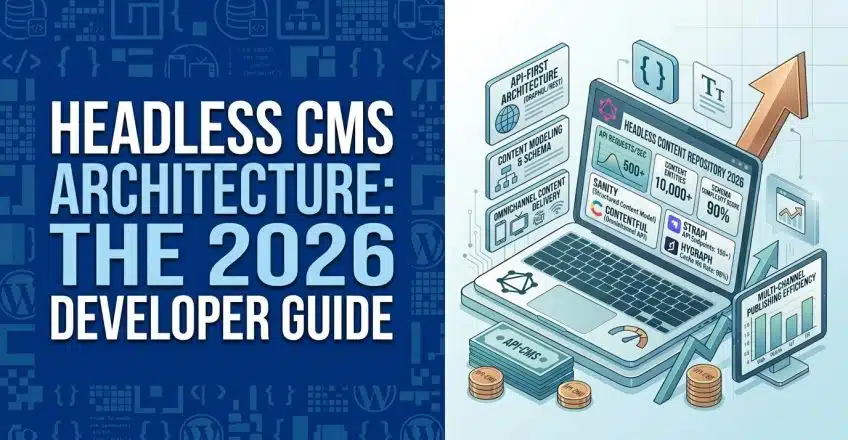

Traditional monolithic content management systems are struggling to keep up with the demands of the modern digital landscape. When your database, administrative dashboard, and frontend design are tightly coupled into a single codebase, scaling becomes incredibly difficult. If you want to push an article to your website, a mobile application, and a digital smart display simultaneously, a traditional CMS forces you to build messy, slow workarounds. To solve this, engineering teams are rapidly abandoning legacy platforms in favor of decoupled, API-first environments that offer total frontend freedom.
The Ultimate Guide to Headless CMS Architecture
The fundamental shift in this approach is the complete separation of where content is created and where it is displayed. In a traditional setup, the CMS dictates exactly how the HTML is rendered on the page. In a decoupled setup, the backend acts purely as a content repository. Editors write articles and upload images into a clean interface, and that data is simply stored and exposed via a RESTful API or GraphQL endpoint.
Because the backend has no opinion on how the data looks, your frontend developers are entirely free to consume that API using modern Javascript frameworks like Next.js, Vue, or Svelte. This results in blazing-fast static sites and highly interactive single-page applications that render instantly for the end user.
Core Benefits of Headless CMS Architecture
Transitioning away from a monolith requires a steep initial learning curve, but the long-term operational advantages fundamentally change how your business delivers digital experiences to the market.
-
True Omnichannel Delivery: You write a product description once in your database, and the API instantly distributes it to your eCommerce website, your native iOS application, and your automated email marketing campaigns without requiring duplicate data entry.
-
Bulletproof Security: Because your frontend presentation layer is completely disconnected from your database, traditional SQL injection attacks and brute-force login attempts against your public-facing website become mathematically impossible. The database simply does not exist on the public server.
-
Unrestricted Developer Flexibility: Your engineering team is never forced to learn outdated PHP templating languages just to change a button color. They can build the user interface using the absolute latest frontend technologies while the backend content team works without interruption.
Top Platforms for Headless CMS Architecture
Selecting the right provider determines how easily your developers can model data and how comfortably your marketing team can publish articles. The 2026 ecosystem offers powerful solutions tailored to different engineering scales.
-
Strapi: As the leading open-source option, this Node.js-based platform allows you to completely customize your API endpoints and host the entire database on your own servers, giving you absolute ownership of your data.
-
Sanity: Designed for highly complex, structured data, this platform offers a real-time collaborative workspace. It treats content as pure data, allowing massive enterprise teams to edit the same document simultaneously without version conflicts.
-
Contentful: This enterprise-grade, cloud-hosted platform abstracts away the server management entirely. It provides an incredibly robust global Content Delivery Network (CDN) to ensure your API payloads are delivered with zero latency anywhere in the world.
Serving dynamic API payloads to thousands of concurrent users requires a backend that will never bottleneck under pressure. If your infrastructure is weak, your decoupled frontend will simply display blank loading screens. Deploy your robust, API-driven web applications on SternHost today. For just ₦1,195.00/month, you receive the enterprise-grade speed, unmetered bandwidth, and raw server processing power necessary to scale your modern digital architecture flawlessly 24/7.