
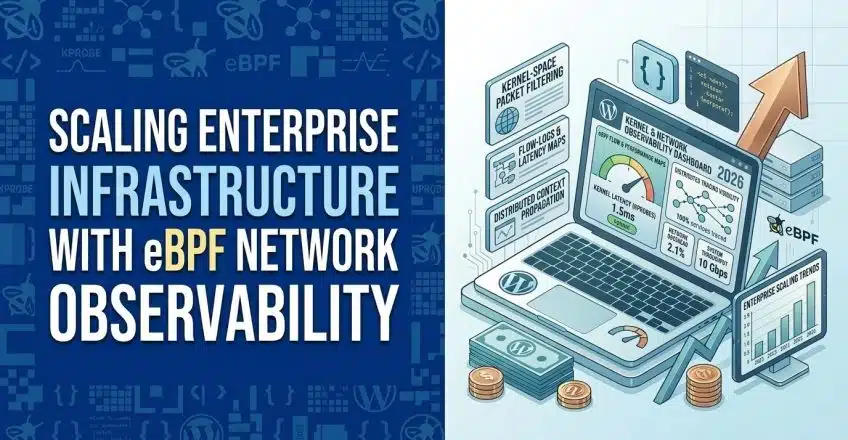

Traditional monitoring tools for containerized microservices often introduce unacceptable performance overhead and blind spots. When managing high-throughput global infrastructure, relying on sidecar proxies or user-space packet sniffing creates latency bottlenecks and consumes excessive CPU cycles. By pushing tracing capabilities directly into the Linux kernel, systems engineers can intercept socket operations and network packets without altering the application code or deploying heavyweight daemonsets.
Scaling Enterprise Infrastructure with eBPF network observability
Operating at the kernel level provides an unprecedented vantage point for monitoring distributed architectures. Instead of waiting for packets to traverse the entire network stack and reach user space, telemetry logic is executed safely within the kernel environment. This allows for the immediate identification of TCP drops, DNS resolution latencies, and microservice communication bottlenecks across thousands of ephemeral nodes.
Architectural Foundations of eBPF network observability
Integrating this paradigm requires compiling C-based tracing programs into restricted bytecode, which is then verified for safety before being loaded into the kernel. This verification engine ensures that the tracing code cannot crash the operating system or enter infinite loops. Once attached to specific hooks such as tracepoints, kprobes, or XDP (eXpress Data Path), the bytecode collects granular telemetry data seamlessly.
-
Bypassing the traditional TCP/IP stack enables ultra-low latency packet filtering directly at the network interface card level.
-
Dynamic instrumentation allows engineers to attach and detach probes in real time without restarting backend services or disrupting active connections.
-
Kernel-level aggregation reduces the volume of telemetry data exported to external time-series databases by computing metrics locally before user-space transmission.
Implementing eBPF network observability in Global Clusters
Deploying this architecture across a multi-region Kubernetes fleet requires a centralized control plane capable of managing bytecode distribution and aggregating the resulting telemetry streams. Tools like Cilium or Pixie leverage this kernel technology to construct detailed service dependency maps and enforce zero-trust network policies without modifying individual pod manifests. By capturing HTTP/gRPC payloads and cryptographic handshake metrics at the socket layer, systems builders gain complete visibility into encrypted traffic flows traversing the mesh network.
Extracting maximum value from kernel-level telemetry requires underlying hardware that guarantees consistent I/O processing and stable network routing. Deploy your fast, secure web applications on SternHost today. For just ₦1,195.00/month, you receive the enterprise-grade caching, unmetered bandwidth, and raw server processing speed necessary to scale your operations flawlessly 24/7.