
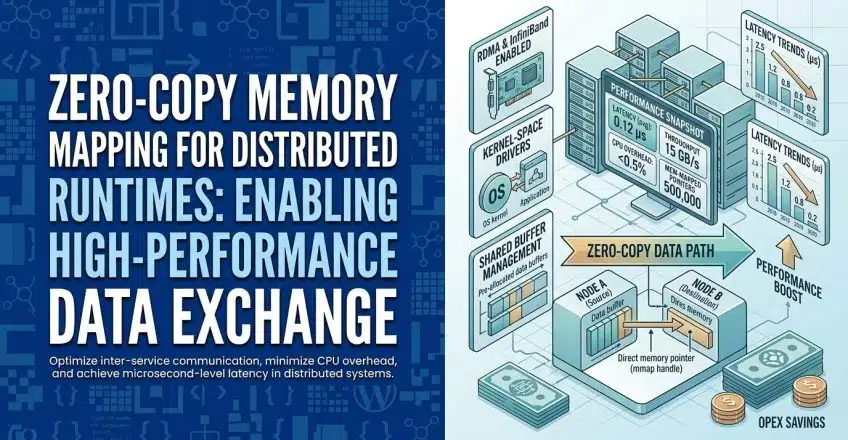

High-throughput distributed runtimes frequently suffer from performance degradation due to memory copying overhead between user space and kernel space. When microservices process gigabytes of streaming data per second, traditional socket I/O operations force the CPU to constantly move data blocks across distinct isolation boundaries. This data migration consumes critical CPU cycles and causes frequent cache invalidations, capping the maximum network throughput of the application layer. Eliminating this performance bottleneck requires bypassing standard intermediate serialization buffers entirely.
Optimizing High-Throughput Architectures via Zero copy memory mapping
To achieve true line-rate performance in multi-tenant cloud environments, software engineers must re-engineer how applications interact with volatile memory. Conventional input/output patterns utilize read and write system calls that copy data from the network interface card into kernel buffers, then into application-allocated space, and often through multiple internal microservice abstraction layers.
Deploying Zero-copy memory mapping removes these intermediate memory duplication cycles completely. By configuring direct memory access channels, the host operating system allows application runtimes to read network packets directly from a shared memory ring buffer, freeing the CPU to focus entirely on core business logic execution.
System Architecture for Zero copy memory mapping
Establishing an architecture based on shared memory spaces requires precise alignment between hardware drivers, kernel page tables, and user-space virtual memory management. System engineers rely on advanced kernel abstractions to synchronize state across boundaries without causing race conditions or memory fragmentation.
-
Memory-mapped files expose block storage directly to the application’s virtual address space, enabling low-latency read and write operations without explicit read system calls.
-
Ring buffers facilitate thread-safe, lock-free communication between asynchronous processing components, guaranteeing consistent data sequencing at scale.
-
Page table manipulation allows the runtime to transfer ownership of physical memory pages between different processing contexts without moving the actual data.
Implementing Zero copy memory mapping in Production Systems
Integrating this memory management paradigm within enterprise distributed databases involves leveraging kernel primitives like mmap and io_uring. This infrastructure completely decouples the storage engine from standard blocking file operations, allowing asynchronous workers to access data pages concurrently.
C
// Abstract representation of direct ring buffer mapping
int fd = open("/dev/shm/data_node", O_RDWR);
void *shared_region = mmap(NULL, REGION_SIZE, PROT_READ | PROT_WRITE, MAP_SHARED, fd, 0);
By binding application worker threads directly to specific CPU cores and utilizing huge pages to reduce translation lookaside buffer (TLB) misses, runtimes achieve deterministic processing speeds even under peak workloads. This approach eliminates garbage collection pauses caused by object allocation spikes, enabling enterprise platforms to maintain flat p99 latency profiles across global networks.