
The era of isolated, passive chatbots is rapidly coming to a close. As we move deeper into 2026, the artificial intelligence landscape is fully pivoting toward agentic workflows, where models do not just answer questions—they actively execute tasks across complex development environments. For full-stack developers relying on rapid prototyping and vibe coding to launch applications, the latest industry shifts are fundamentally changing how we architect and deploy software. The recent announcements from Apple, OpenAI, and Google signal a massive move away from closed ecosystems and toward flexible, API-driven automation.
The Core AI Developer Updates Reshaping Software in 2026
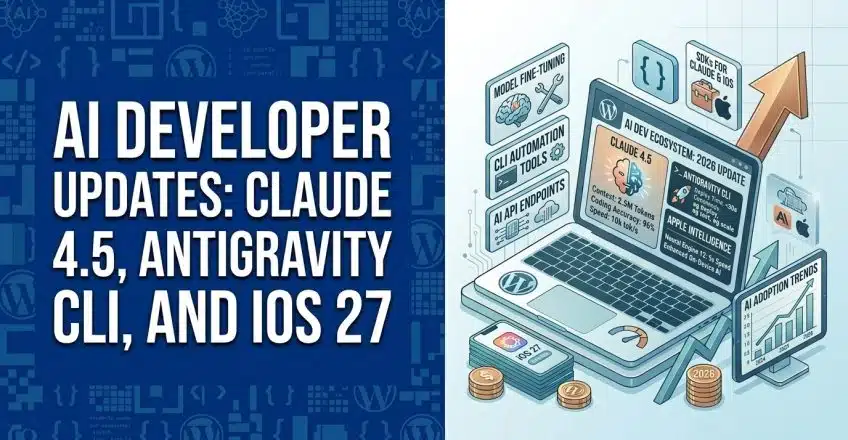
The most significant shift for those building intelligent systems is the transition of development tools from basic syntax autocomplete assistants to autonomous agents. Google recently announced that it is officially transitioning the Gemini CLI into the new Antigravity CLI. This is not just a rebranding; it is a structural acknowledgment that agent-first development is the new baseline standard.
By utilizing tools like the Antigravity CLI alongside Lovable or Claude Code, engineers can spin up entire application architectures through natural language. However, this level of rapid prototyping requires a deep understanding of how these models interact with your codebase. The new CLI environments offer hardened terminal sandboxing and governed workflows. This ensures that when your AI agent is vibe coding a complex database migration, it does not accidentally compromise your application’s foundational security.
How Apple WWDC Drives Global AI Developer Updates
While Google focuses heavily on the developer backend, Apple is completely restructuring consumer distribution. At the upcoming WWDC event, Apple is expected to announce iOS 27, featuring a totally rebuilt Siri powered natively by Google’s Gemini. But the most disruptive news is Apple’s strategic decision to act as an AI distributor rather than exclusively a model builder.
The new iOS 27 architecture will reportedly allow users to choose their default AI provider at the system level. Whether a user prefers ChatGPT 5.5—which now heavily focuses on mathematical and scientific reasoning—or Anthropic’s Claude, they can swap their default engine instantly. For developers maintaining a strong focus on Search Engine Optimization, this multi-model ecosystem means your content and digital platforms must be structured to be easily parsed and cited by multiple different AI engines simultaneously, rather than optimizing for just traditional search crawlers.
Securing Production Systems During AI Developer Updates
As models become more autonomous, the risks associated with deploying them in production increase exponentially. Anthropic recently expanded its ecosystem with a groundbreaking “Computer Use” feature, allowing Claude to run complex tasks on your behalf directly within a user interface.
However, the rollout of the Claude 4.5 upgrade highlighted the massive “blast radius” these updates can have on production systems. When the model was updated, developers noted that it fundamentally changed how it handled JSON payloads and specific API calls. When your entire infrastructure relies on rapid vibe coding and natural-language-to-code translations, a minor update to the underlying model’s logic can completely sever your application’s connection to its database.
-
Enforce Evals-First Architecture: You can no longer rely purely on basic prompt engineering. You must build an evaluation suite that constantly tests the AI’s output against strict formatting rules before it is allowed to execute live API calls.
-
Lock Your Model Versions: Never deploy a dynamic “latest” tag in your production code. Always lock your API calls to a specific model version (such as Gemini 2.5 Flash) to ensure an unexpected vendor update does not crash your live platform overnight.
The speed at which you can now build, test, and deploy applications is unprecedented. However, running these multi-step, agent-driven workflows requires uncompromised backend performance. Ensure your server infrastructure provides the raw processing power and unmetered bandwidth necessary to support continuous, heavy API requests, so your automated platforms remain lightning-fast and perfectly responsive.