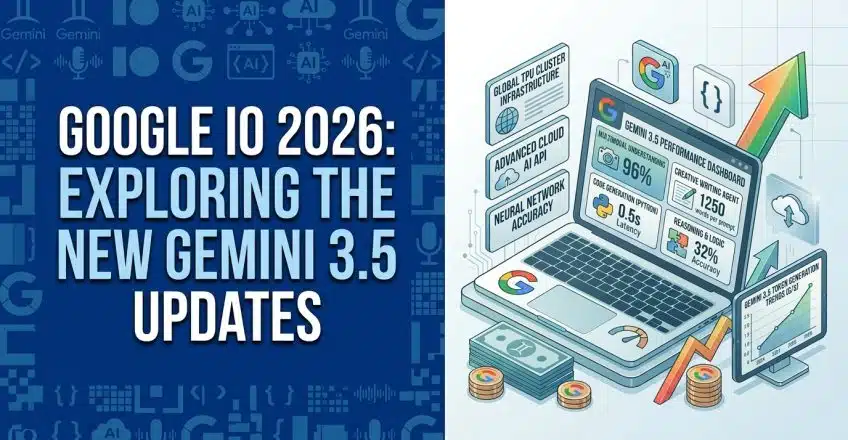

The transition from passive artificial intelligence to fully autonomous, action-driven systems is officially complete. This year’s developer conference fundamentally shifted the focus away from basic chatbots and toward comprehensive operational automation. For developers and business leaders looking to rapidly deploy full-stack applications or streamline complex logistics, the announcements surrounding the latest machine learning architectures provide the exact tools needed to scale without linearly increasing overhead. The new ecosystem prioritizes market value and execution over raw specifications, allowing teams to automate the heavy lifting of digital operations completely.
Restructuring Automation with Google IO Updates
The centerpiece of the conference was the unveiling of the next generation of foundational models designed to interact seamlessly with external development environments. Rather than solely chasing parameter size, the new architecture has been heavily optimized for rapid, multi-step execution, massive context handling, and long-term reasoning.
By integrating these models directly into production pipelines, organizations can move away from manual scripting and allow autonomous agents to handle data processing, code optimization, and real-time user interactions. This foundational shift changes how software is built, maintained, and scaled globally.
Unpacking the Core Google IO Updates: The 3.5 Family
The rollout of the new model family represents a massive leap forward in computational efficiency and cost-effectiveness for digital enterprises. These upgrades make advanced reasoning accessible for high-volume production environments without triggering massive API bills.
-
Gemini 3.5 Flash: This brand-new model delivers near-Pro level intelligence while maintaining the exceptional speed and cost-efficiency associated with the Flash tier. It serves as the primary workhorse for high-frequency, low-latency automated workflows.
-
One Million Token Context: The model features a massive context window of over one million input tokens by default. This allows it to ingest and process entire technical codebases, hours of video footage, or expansive financial datasets in a single, comprehensive prompt.
-
Optimized Thinking Effort: The default thinking effort is now set to a balanced medium tier. This provides an optimal mix of processing speed and deep reasoning for everyday tasks, though engineers can manually override this to high for complex algorithmic operations.
-
Built for the Agentic Era: The architecture is explicitly designed to handle sub-agent deployments. It excels at executing long-horizon tasks that require sustained focus, structural memory, and multiple iterative tool calls across isolated environments.
Technical Milestones in the Google IO Updates
Beyond the core text and reasoning engines, the expansion of the multimodal ecosystem introduces highly specialized protocols designed to bridge the gap between AI reasoning and traditional web infrastructure. These protocols ensure that models can interact with the web just like human operators do.
-
Gemini Omni: This framework introduces a groundbreaking, native approach to rich media. It allows users to seamlessly blend text, audio, images, and video inputs to generate and iteratively edit high-quality, dynamic video content through fluid, real-time natural conversation.
-
Gemini Spark: Operating as a 24/7 personal AI agent, Spark runs continuously in the background of your digital workspace. It autonomously executes complex multi-step actions across connected apps, navigating daily admin workflows under your explicit direction.
-
The WebMCP Protocol: To standardize how browser-based agents interact with websites, this proposed protocol allows developers to expose structured tools safely. It ensures that AI agents can interact with HTML forms and JavaScript functions reliably without breaking the user interface.
Developer Workflows and Google IO Updates in Antigravity
For serious software builders, the integration of these models into active development environments is where the true transformation occurs. The release of Antigravity 2.0 leverages these model enhancements to redefine rapid software prototyping.
-
Autonomous Code Maintenance: The platform moves entirely beyond basic code completion autocomplete widgets. It offers a governed, autonomous workflow that actively maintains architectural integrity, fixes runtime errors, and updates documentation throughout every development sprint.
-
Hardened Sandbox Environments: Developers can spin up highly specialized subagents to tackle distinct features simultaneously. Every agent operates within a secure environment featuring cross-platform terminal sandboxing and strict, automated Git commit policies.
-
Massive Operational Cost Reductions: Because the underlying 3.5 architecture is highly optimized, the computational efficiency of running continuous development agents is drastically reduced, allowing startups to achieve production-scale deployment much faster.
Deploying these powerful, autonomous agents and managing the heavy concurrent API streams required for tools like Antigravity demands an uncompromising server architecture. A slow or unstable backend will immediately throttle your multi-step AI workflows, cause API timeouts, and break your background automations. Ensure your digital infrastructure can keep pace with the agentic web by hosting your production applications on SternHost today.