
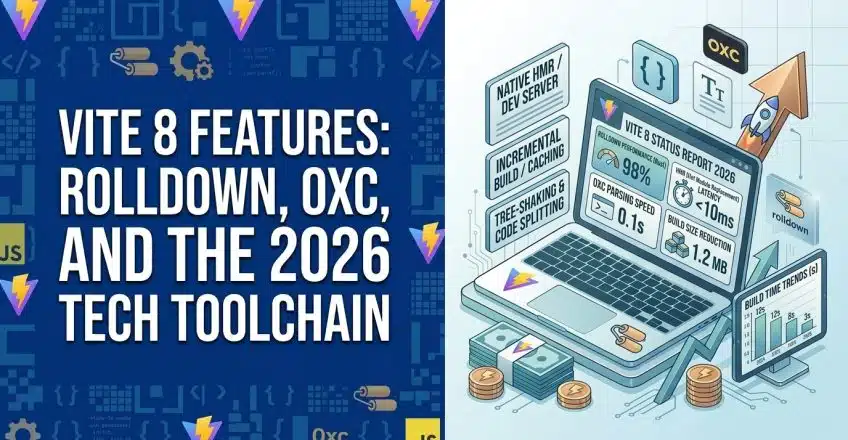

For years, modern frontend development relied on a pragmatic but fragmented dual-bundler approach. Engineering teams used esbuild for lightning-fast development servers and Rollup for heavily optimized production builds. While this system worked, maintaining two separate transformation pipelines required massive amounts of complex code and often led to inconsistent plugin behaviors. In 2026, the frontend ecosystem experienced its most significant architectural shift to date with a brand new release that fundamentally unifies the build process.
Exploring the Core Vite 8 Features
The transition to this new framework version is not a simple incremental update; it is a complete replacement of the underlying engines. The core development team has officially moved away from the esbuild and Rollup dependency model, integrating a unified, Rust-based toolchain built around Rolldown and Oxc.
This architectural alignment means that your development server and your production build now run through the exact same logic. You no longer have to worry that a Javascript plugin functioning perfectly during local development will suddenly fail when you run your final deployment script.
-
Blazing Fast Performance: By utilizing Rolldown, which operates at native Rust speed, production builds are now benchmarking between ten to thirty times faster than the previous Rollup implementation.
-
Full API Compatibility: Despite replacing the entire engine, the transition is seamless. The vast majority of existing plugins work right out of the box because Rolldown was explicitly designed to support the established plugin architecture.
-
End-to-End Consistency: The integration of Oxc as the core compiler ensures consistent behavior across the entire stack, from parsing and resolving syntax to transforming and minifying the final assets.
Advanced Routing and Developer Vite 8 Features
Beyond the massive performance gains of the new bundler, this release introduces several quality-of-life improvements aimed directly at the developer experience. The friction of configuring complex TypeScript environments has been heavily reduced.
-
Built-In Path Resolution: Developers can now enable TypeScript path alias resolution simply by setting the
resolve.tsconfigPathsvariable to true within the configuration file, completely eliminating the need for external third-party path plugins. -
Native Decorator Support: The framework now provides built-in automatic support for the TypeScript
emitDecoratorMetadataoption. This is a massive win for enterprise teams utilizing metadata-heavy architectures like NestJS or Inversify. -
Browser Console Forwarding: A highly requested tool, developers can now forward client-side browser console logs directly into their backend terminal. This activates automatically when an AI coding agent is detected, allowing autonomous programming tools to instantly read runtime errors without requiring the human developer to manually copy and paste the error logs.
Preparing Your Infrastructure for Vite 8 Features
While the new Rolldown integration unlocks a future roadmap of full bundle mode and raw AST transfers, it does slightly increase the initial installation footprint. The addition of the Rolldown binary and the lightningcss dependency adds approximately fifteen megabytes to your project folder, as the team chose to prioritize raw execution speed over binary size.
As frontend frameworks become increasingly reliant on rapid, on-the-fly compiling and complex Node.js runtime environments, your backend server must be equipped to handle these intensive processes. Running advanced build tools on a sluggish, under-resourced shared hosting environment will immediately bottleneck your development workflow and frustrate your engineering team.