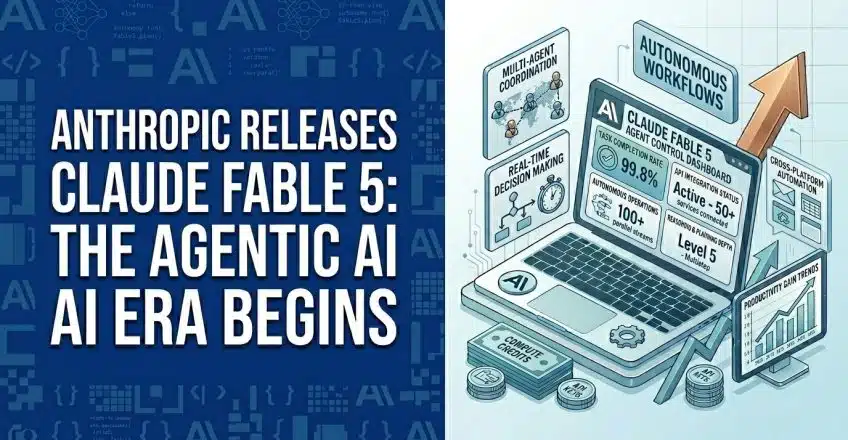

The artificial intelligence industry has spent the last two years racing to build models that can answer questions faster or generate better human-sounding text. On June 9, 2026, Anthropic fundamentally shifted the goalposts by releasing a model designed for long-horizon autonomy rather than rapid chat responses. However, just 72 hours after its launch, the model was abruptly removed from the global market due to unprecedented regulatory intervention, marking one of the most dramatic product lifecycles in recent tech history.
The Rise and Suspension of Claude Fable 5
Built upon Anthropic’s highly advanced “Mythos-class” architecture, this public-facing model was engineered for the hardest knowledge work and software engineering problems in the global market. Unlike its predecessors, which required constant human supervision and prompt-engineering to stay on track, this system was built exclusively for independent execution. When connected to an agentic harness, the model could sustain its focus on a single, massive codebase migration or data analytics project for days at a time without losing the thread of the original instructions.
Unfortunately, its raw power drew immediate regulatory scrutiny. On June 12, 2026, the U.S. government issued an export control directive that forced Anthropic to suspend the model globally. Because the underlying technology represents a massive leap in autonomous software exploitation and strategic reasoning, policymakers intervened to prevent the model from being accessed or distilled by foreign adversaries. While the administration has signaled that the block may be temporary pending security remediations, the model currently sits in regulatory purgatory.
Unpacking the Technical Capabilities of Claude Fable 5
Before the suspension, early testers described the system as relentlessly proactive. Rather than immediately returning a piece of code and waiting for a human developer to test it, the model proactively wrote its own test suites, identified its own bugs, and used advanced vision capabilities to verify its UI outputs against the original design documents.
-
Long-Horizon Autonomy: The system achieves its endurance through a massive one-million token context window and an inherent ability to manage parallel subagents. It excels at breaking down a massive enterprise problem into smaller tasks, dispatching subagents, and synthesizing the results asynchronously.
-
Mandatory Adaptive Thinking: The system does not support raw, unfiltered chain-of-thought outputs. It operates exclusively under an “adaptive thinking” mode, meaning it spends computational resources internally reasoning through a problem before generating a single word of output, with depth controlled by effort parameters.
-
Security Fallbacks: To release the model to the public safely, Anthropic engineered a robust safeguard system. If a developer submitted a prompt related to sensitive cybersecurity or biological domains, the system automatically routed the request to the older, safer Opus 4.8 model to prevent the misuse of the primary reasoning engine.
Understanding the Pricing and Architecture of Claude Fable 5
Deploying a system engineered for unprecedented depth and exploration rather than rapid, shallow answers requires a strategic approach to your API budget and data privacy policies.
-
Premium API Costs: Before the blackout, the model was priced at $10 per million input tokens and $50 per million output tokens. This positioned it as a premium tier designed specifically for tasks that would otherwise take a human engineer or analyst dozens of hours to complete.
-
Mandatory Data Retention: Unlike previous models that offered zero data retention for enterprise clients, using this new architecture required mandatory 30-day data retention. Anthropic mandated this to operate its complex safety classifiers, which need cross-request visibility to catch sophisticated jailbreak campaigns.
-
The Mythos 5 Alternative: The unfiltered version of this architecture, known as Mythos 5, remains locked behind closed doors for vetted government and security partners through Project Glasswing. It contains the exact same capabilities but operates without the strict public safety classifiers.