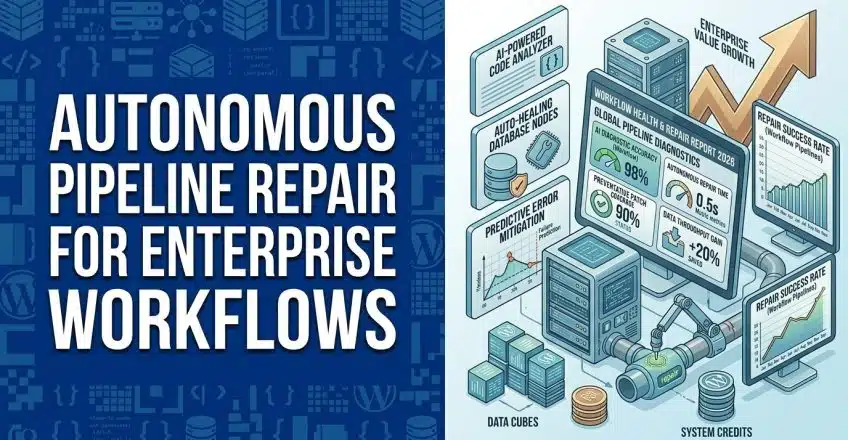

The modern software development lifecycle relies heavily on automated testing to prevent regressions, but the manual remediation of broken builds remains a massive efficiency drain. When a continuous workflow fails due to a stale dependency, a minor linting violation, or a broken test assertion, a developer must break their flow state, dig through terminal logs, write a patch, and wait for the system to run again. For enterprise teams deploying multiple times a day, this constant context-switching compounds into hundreds of lost engineering hours every month. Transitioning from basic automation to autonomous resolution requires embedding intelligent agents directly into the deployment pipeline to act as an automated feedback loop.
Automating Issue Resolution with Autonomous pipeline repair
Building an intelligent deployment ecosystem fundamentally changes how engineering teams treat broken builds. Instead of a failure acting as a roadblock that halts production, it becomes a trigger for an automated debugging workflow. By integrating artificial intelligence directly into the build environment, systems can dynamically interpret stack traces, locate the offending code snippet, and synthesize a functional repair strategy without human intervention.
The Architecture Behind Autonomous pipeline repair
Deploying autonomous remediation requires a strict architectural boundary to ensure security and predictability. Unlike standard coding assistants that operate within a local integrated development environment, pipeline agents execute inside isolated, sandboxed containers triggered by webhook events from platforms like GitHub Actions or GitLab CI.
-
Failure detection immediately captures execution logs and identifies whether an error is transient or requires a permanent codebase patch.
-
AI analysis models process the failing test assertions alongside the repository structure to diagnose the root cause accurately.
-
Automated remediation agents write the code fix, push a new branch, and generate a pull request complete with an explanation of the applied solution.
Implementing Agentic Workflows for Autonomous pipeline repair
Setting up this infrastructure involves utilizing orchestration tools that securely connect language models to version control systems. When a primary workflow fails, an event listener triggers a secondary recovery pipeline. This isolated pipeline provides the AI agent with read-only access to the source code and logs, alongside explicitly declared write permissions limited strictly to creating new branches and pull requests. By utilizing graph databases to map codebase relationships or vector databases to recall historical failure patterns, these agents achieve remarkably high success rates in generating accurate patches. Developers no longer hunt for missing semicolons or deprecated API calls; they simply review the automatically generated pull request, merge the fix, and continue building.