
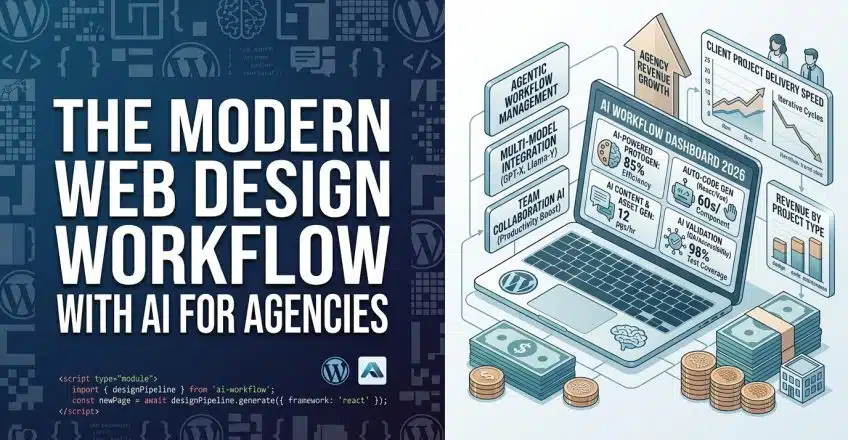

The timeline for delivering enterprise-grade websites has collapsed dramatically as generative development tools move beyond simple text-based chatbots. Today, relying on manual translation from static Figma mockups to front-end code creates unnecessary production bottlenecks and increases the risk of human error during handoff. By integrating autonomous generation tools directly into the development pipeline, agencies can synthesize production-ready React or Tailwind components instantly from plain language prompts or vector design systems. This shift fundamentally changes how digital studios manage client expectations, allowing teams to prototype fully functional, database-connected interfaces in days rather than weeks.
Architectural Pillars of a Modern web design workflow with AI
Transitioning away from a traditional waterfall development cycle requires adopting toolchains that bridge the gap between ideation and deployment. Advanced browser-based development environments now feature embedded agentic systems that read design documentation, configure routing, and establish optimal visual hierarchies automatically. This removes the tedious process of writing boilerplate CSS variables and allows developers to focus strictly on custom business logic and performance tuning.
-
Component-level generation allows developers to instantly convert vector graphics into responsive flexbox containers natively.
-
Real-time accessibility remediation algorithms actively scan the Document Object Model to fix color contrast ratios and append ARIA tags before deployment.
-
Integrated state management systems automatically generate database schemas and backend connectivity alongside the visual interface.
Refining Prototypes within a Modern web design workflow with AI
The true power of this methodology lies in its capacity for rapid, conversational iteration. Rather than manually clicking through nested element trees to adjust padding, developers can prompt the interface to adjust whitespace, refine typography choices, or match a specific brand’s aesthetic globally. Because the underlying AI understands modern framework architecture, every structural change is immediately compiled into clean, accessible code that avoids the bloat typical of visual page builders.
Deploying complex, AI-generated front-end architectures requires underlying hardware optimized for extreme compute throughput. Deploy your fast, secure web applications on SternHost today. For just ₦1,195.00/month, you receive the enterprise-grade caching, unmetered bandwidth, and raw server processing speed necessary to scale your operations flawlessly 24/7.Focus Keyword: Modern web design workflow with AI
SEO Title: Modern web design workflow with AI for Agencies
Meta Description: Streamline your agency build cycle using a modern web design workflow with AI to launch high-converting, lightning-fast sites without writing boilerplate code.
Slug: /modern-web-design-workflow-with-ai
Scaling Agency Production Using a Modern web design workflow with AI
The timeline for delivering enterprise-grade websites has collapsed dramatically as generative development tools move beyond simple text-based chatbots. Today, relying on manual translation from static vector mockups to front-end code creates unnecessary production bottlenecks and increases the risk of human error during handoff. By integrating autonomous generation tools directly into the development pipeline, agencies can synthesize production-ready React or Tailwind components instantly from plain language prompts or vector design systems. This shift fundamentally changes how digital studios manage client expectations, allowing teams to prototype fully functional, database-connected interfaces in days rather than weeks.
Architectural Pillars of a Modern web design workflow with AI
Transitioning away from a traditional waterfall development cycle requires adopting toolchains that bridge the gap between ideation and deployment. Advanced browser-based development environments now feature embedded agentic systems that read design documentation, configure routing, and establish optimal visual hierarchies automatically. This removes the tedious process of writing boilerplate CSS variables and allows developers to focus strictly on custom business logic and performance tuning.
-
Component-level generation allows developers to instantly convert vector graphics into responsive flexbox containers natively.
-
Real-time accessibility remediation algorithms actively scan the Document Object Model to fix color contrast ratios and append ARIA tags before deployment.
-
Integrated state management systems automatically generate database schemas and backend connectivity alongside the visual interface.
Refining Prototypes within a Modern web design workflow with AI
The true power of this methodology lies in its capacity for rapid, conversational iteration. Rather than manually clicking through nested element trees to adjust padding, developers can prompt the interface to adjust whitespace, refine typography choices, or match a specific brand’s aesthetic globally. Because the underlying generative model understands modern framework architecture, every structural change is immediately compiled into clean, accessible code that avoids the bloat typical of older visual page builders.