
The transition from reactive generative models to autonomous execution engines represents a monumental shift in how engineering teams manage global infrastructure. As systems scale horizontally across multiple cloud providers, maintaining performance, resolving dependency conflicts, and patching security vulnerabilities manually becomes a structural bottleneck. Integrating autonomous agents directly into the software development lifecycle (SDLC) shifts the operational burden from human engineers to intelligent, self-executing systems. These systems do not just predict code; they utilize dynamic AST (Abstract Syntax Tree) parsing, execute containerized sandbox tests, and proactively restructure architecture before latency spikes affect end-users.
Advanced Technical use cases for agentic AI in Enterprise Architecture
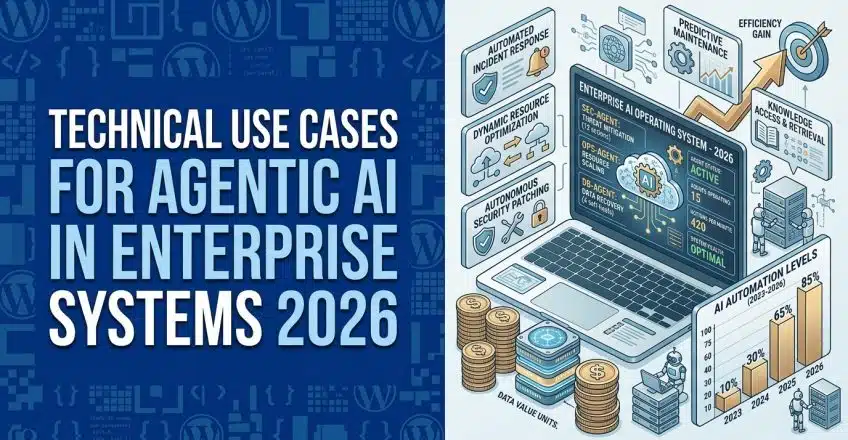
Modern distributed systems require a level of continuous orchestration that traditional static CI/CD pipelines cannot provide. When an enterprise application spans hundreds of microservices, a single deprecated library or misconfigured environment variable can trigger cascading deployment failures. Instead of waiting for a DevOps engineer to manually trace log outputs and revert commits, agentic workflows intercept the failure state, analyze the stack trace, and synthesize a functional patch autonomously. This capability effectively transforms the build pipeline into a self-healing ecosystem.
-
Automated dependency resolution across legacy and cloud-native microservices
-
Real-time vulnerability patching using isolated MicroVM testing environments
-
Dynamic infrastructure provisioning based on predictive application load
Exploring Technical use cases for agentic AI in CI/CD Pipelines
Deploying autonomous agents into continuous integration workflows eliminates the friction of manual code reviews and pipeline debugging. In a traditional setup, a failed build triggers an alert, forcing an engineer to context-switch, read the terminal output, and push a fix. Implementing an agent-driven pipeline allows the system to read the terminal error, browse the internal documentation repository for the latest API specifications, rewrite the failing test or source code, and initiate a new pull request with the verified fix.
By operating entirely within a secure, terminal-sandboxed environment, the agent can safely execute trial-and-error operations without risking production data or modifying host configurations. The agent evaluates the execution environment, runs unit tests in parallel, and applies the optimal architectural pattern without human prompting.
Autonomous Code Refactoring as Technical use cases for agentic AI
One of the most complex challenges in legacy modernization is identifying and untangling tightly coupled architectural patterns. Human-led refactoring is incredibly time-consuming and prone to regression errors. By utilizing agentic workflows, systems builders can assign an agent to map the entire repository’s architecture, identify monolithic bottlenecks, and propose strict microservice boundaries. The agent can then systematically extract logic into isolated services, write the corresponding gRPC or REST interface definitions, and generate the necessary Kubernetes deployment manifests.
-
Executing multi-step code translation from legacy frameworks to modern React or Go architectures
-
Generating deterministic unit tests for newly isolated edge functions
-
Analyzing telemetry data to identify and rewrite inefficient database queries autonomously